What Is a Declaration of Domicile? (2026)
Quinn Moran · Published
iReside is the app that tracks your days for tax residency and visa stays, and gives you audit-ready proof of where you were for the tax authority or immigration officer who asks.
A declaration of domicile is a sworn statement that a particular place is your permanent home, filed so that there is a dated record of it. In Florida it is made under Fla. Stat. 222.17: you sign it under oath and the clerk of the circuit court records it. Filing is optional, and it is evidence of where you intend your domicile to be, not proof. The state you left still decides for itself whether you moved, and it looks at your days and your life, not one filing.
The iReside app
A declaration states your intent. Your day record shows what you did.
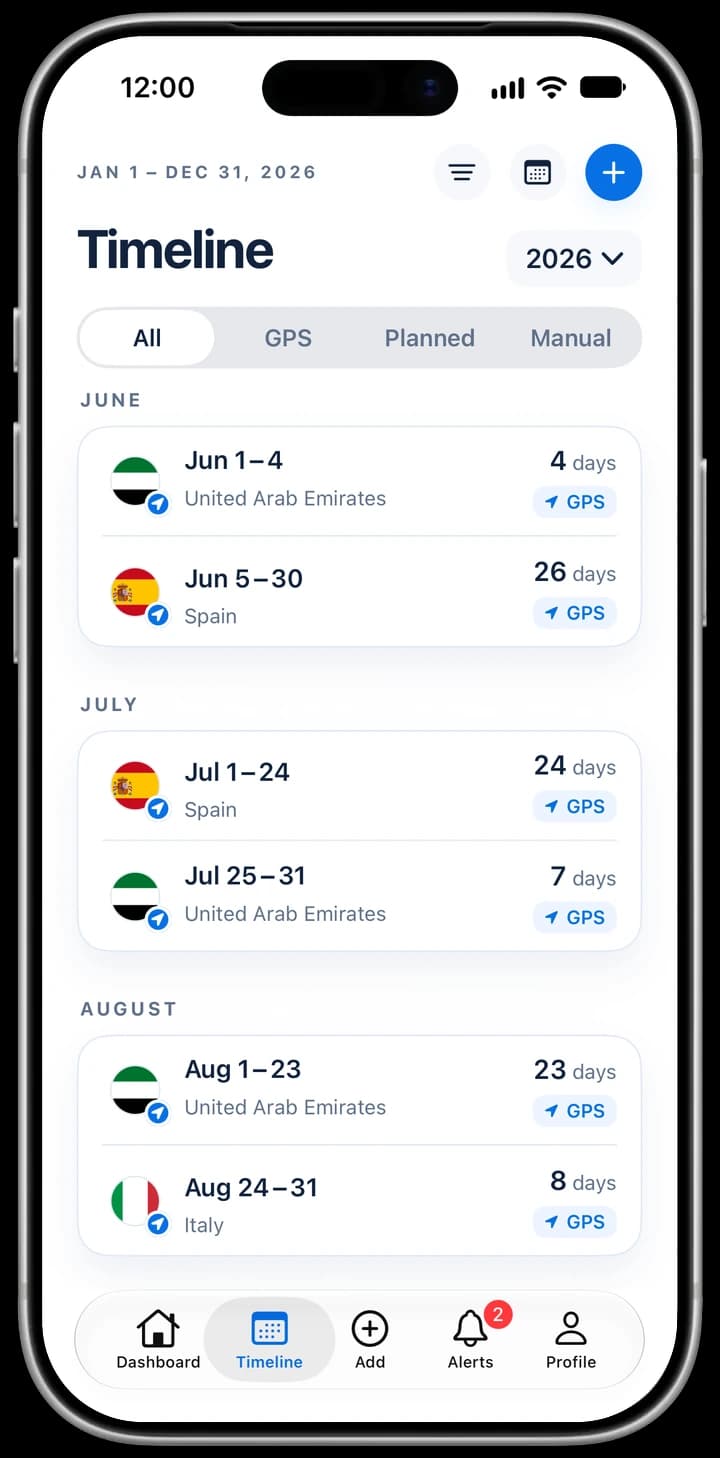
A declaration of domicile is one dated statement, and it does not prove domicile on its own. Time is one of the five primary factors New York weighs, and a record made at the time carries more weight than one rebuilt later. iReside tracks your days automatically for tax residency and produces an audit-ready PDF report: auditable proof of where you were.
- Counts your days by state in the background, with nothing to log by hand
- A day-by-day timeline of where you were
- Produces an audit-ready PDF report you can hand to your CPA
$44.99/year after free trial. Cancel anytime.
On this page

A declaration of domicile is a sworn statement that a place is your permanent home. You sign it under oath and file it with a government office, so that a dated record exists of where you say you intend to make your permanent home. This page covers Florida's version, the one we have researched: what it says, who can file it and what it does not prove. For county-by-county filing steps and fees, see the Florida declaration of domicile form guide.
Domicile in one paragraph
Your domicile is your permanent legal home: the place you intend to return to whenever you are away. It is decided by intent and facts, and it has no day minimum. You keep a domicile until you abandon it and establish a new one, which is why people leaving a high-tax state are asked to show, with evidence, that they changed it. The evidence a state weighs is set out in our domicile proof checklist.
What a declaration of domicile is
The declaration this page covers is Florida's. Section 222.17 of the Florida Statutes, "Manifesting and evidencing domicile in Florida", has been law since 1941. It is the filing we have researched, so it is the only one we describe. Other states have their own rules, or none; read the statute or ask the county before assuming it works the same way.
Under section 222.17:
- A person who has established a Florida domicile may file a sworn statement with the clerk of the circuit court for the county where they live, saying they live in and keep a place of abode there that they intend to maintain as their permanent home.
- A person who also keeps a home in another state may state that their Florida home is their predominant and principal home and that they intend to keep it that way permanently.
- The statement must also contain a declaration that the person is a bona fide Florida resident, their Florida place of residence, the city, county and state where they formerly lived, and any other places where they keep a home.
- It must be signed under oath before an official authorized to take affidavits. The clerk records it in a book kept for the purpose and collects the service charge set by section 28.24.
- The Department of Legal Affairs prescribes the form and gives it to the clerks.
- Filing is optional. The statute says a person "may" file, and it says it does not repeal other existing ways of proving domicile.
Because the statement must list your former home and any other homes you keep, it works as a sworn description of your situation on one date. An auditor can set it beside your property records and your calendar.
Filing in the other direction
Subsection (4) covers someone who is domiciled in a state other than Florida but who has a place of abode in Florida, or has done things there that might be read as showing a Florida domicile. That person may file a sworn statement, in any Florida county where they have a place of abode or did those acts, naming their home state and saying they intend to keep their domicile there. It can also list acts they do not want read as an intention to become a Florida domiciliary. It puts your intent on the record. It does not change your domicile by itself.
What it does not prove
A declaration is evidence of intent on the date you signed. It does not decide the question that costs money, which is whether the state you left agrees that you left.
- It does not bind the old state. New York, for example, keeps you a domiciliary until you show by clear and convincing evidence that you changed it, and its auditors weigh five primary factors: home, business involvement, time, family and items near and dear to you. Paperwork comes after those.
- It does not stop a day count. If you keep a home in a state like New York and spend more than 183 days there, you can be taxed as a statutory resident whatever you filed in Florida. See the 183 day rule and the 183 day rule calculator.
- It is recorded. The clerk records it in a book kept for the purpose, so it sits in the county's records.
- It can be contradicted. A declaration dated in March followed by a summer in the old house tells an auditor the opposite of what you swore.
Before you file: a short checklist
- You already live in the Florida home you are declaring, and intend to keep it as your permanent home.
- You have listed every other place where you keep a home, including the one you left.
- You have a notary or other official who can take your oath, and whatever identification that official requires.
- You have your county clerk's current form and fee schedule.
- You will keep the recorded copy, which shows the date, with the rest of your records.
- You have a plan to record your days, because the declaration states your intent and the days show what you did.
iReside covers the second half. It counts your days in each state and country by GPS in the background, so there is nothing to log by hand, and it produces an audit-ready PDF report of your days. A tax residency tracker kept from the day you move gives you a record made at the time, which is worth more than one rebuilt later.
Download free on the App Store