Global Mobility Compliance for Family Offices
Quinn Moran · August 25, 2026
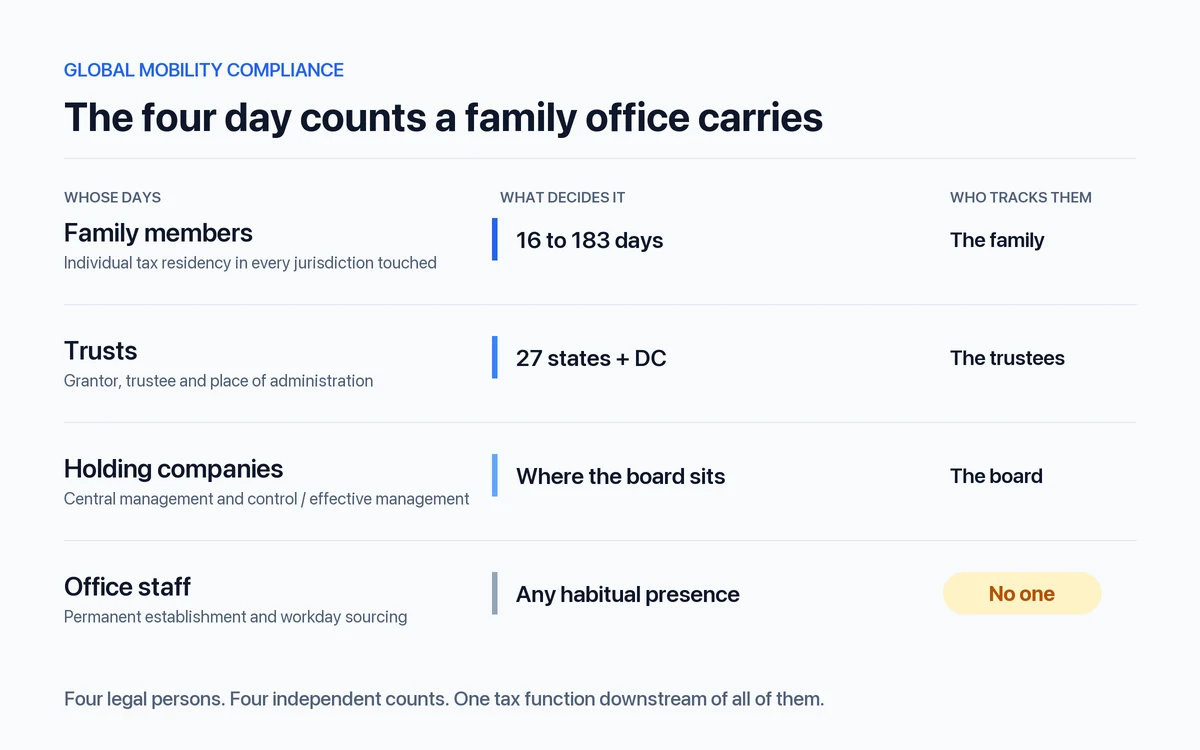
Global mobility compliance for a family office means keeping four independent day counts: each family member's personal tax residency, the residence of trusts keyed to trustee and administration location, the corporate residence of holding entities decided by where directors actually meet, and permanent-establishment exposure created by staff working abroad. Most offices formally own none of them.
On this page
A single-family office will know the currency exposure on a position to the basis point. It will know the exact date a lock-up expires, the vesting schedule on a manager's carry, and the fee load on every line of the consolidated statement.
Ask the same office how many days the principal's eldest daughter spent in the United Kingdom last tax year, and you will usually get a pause, then an offer to go and ask her.
That asymmetry is the whole problem. Family offices were built to steward capital, and capital is the thing they measure. But an increasing share of what actually determines the family's tax outcome is not a property of the capital at all. It is a property of where people physically were, on which days, and whether anyone can prove it two years later.
The tooling for this is not exotic. iReside is one of a small number of apps that records which country, state, or province someone was in each day from their phone's own location, which turns the count from an annual reconstruction into something that already exists when it is needed. But the tool is the easy part. The hard part, and the reason offices that have bought tools still get caught, is that a family office does not have one day count to keep. It has four, they belong to different legal persons, and in most offices no single role owns them.
Count one: family members' tax residency days
The obvious one, and still the one most often done badly.
Every adult in the family has an individual tax residency position in every jurisdiction they touch. That position is decided by mechanical tests that turn substantially on days: the US Substantial Presence Test and its weighted three-year formula, the UK Statutory Residence Test and its tie tables, the 183-day statutory-residence rules in most US states, and the equivalent tests in every other country the family spends real time in.
Two things make this harder for a family office than for an individual.
The population is larger than the org chart suggests. It is not the principal. It is the principal, the spouse, the adult children who are building their own positions and often their own citizenship applications, and sometimes an elderly parent whose care arrangements have quietly created a presence pattern nobody assessed. Each one is an independent test in an independent set of jurisdictions.
The positions interact. A UK-resident spouse is itself a tie under the UK's SRT, and a spouse's location is a weighted factor in most US state domicile analyses. A child at school in a jurisdiction can be a connecting factor for a parent. The family's positions are not four separate problems; they are one problem with four moving parts, and it is normal for the optimal answer for one person to be the wrong answer for another.
The failure mode here is rarely a wild miscount. It is a position built at 178 days that nobody was watching in November, closing the year at 189.
Count two: trust residency and where trustees sit
This is the count that most reliably surprises people, because nothing about it feels like a travel problem.
Trust residence is not universally determined the same way, and that is precisely the issue. Different jurisdictions key it to different facts:
- The trustees' residence. In the UK and much of the Commonwealth, where the trustees are resident is central to where the trust is resident. A trustee who relocates changes the analysis.
- Where the trust is administered. Several jurisdictions look at where the real administration happens, which is a question about people and meetings rather than about a registered address.
- The grantor's residence at creation. Twenty-seven US states and the District of Columbia define a resident trust by reference to the grantor's residence when the trust was created, a fact that is fixed at settlement and then travels with the trust indefinitely.
The US position has been narrowed but not resolved. In North Carolina Department of Revenue v. Kimberley Rice Kaestner 1992 Family Trust, decided unanimously in 2019, the Supreme Court held that a state cannot tax undistributed trust income based solely on a beneficiary's in-state residence where that beneficiary has no right to demand the income and no guarantee of ever receiving it. That is a real limit. It is also a narrow one: the Court said its holding does not address laws that weigh a beneficiary's residence as one of several factors, laws that turn on the residence of the settlor, or laws that rely only on noncontingent beneficiaries, and it described trustee residence and the place of administration as recognised bases for taxing a trust.
For a family office, the practical consequence is that individual trustees, and the individuals who direct a corporate trustee, are people whose location has tax consequences for entities they do not personally own. That is a day count. It is almost never kept.
Count three: holding company residence and board meetings
A holding company is tax resident where it is incorporated, and also, potentially, somewhere else entirely.
Most common-law jurisdictions apply some version of a central management and control test: the company is resident where the real decisions are taken, which the courts have historically located by asking where the board actually functions. Tax treaties reach the same territory through place of effective management, the concept that sat in Article 4(3) of the OECD Model as the tie-breaker for dual-resident companies.
Two details matter for a family office.
First, these tests look at substance, not minutes. A board that formally meets in one jurisdiction while the decisions are demonstrably made by a principal in another is the exact fact pattern the tests exist to catch. Where the directors physically were when the substantive decisions happened is evidence, and it is the kind of evidence that a calendar, a phone, and a set of travel records will eventually be asked to produce.
Second, the safety net got weaker. The 2017 update to the OECD Model replaced the automatic place-of-effective-management tie-breaker with a mutual agreement procedure: where a treaty follows the current Model, dual corporate residence is resolved by the two tax administrations negotiating, not by a rule you can apply in advance. Treaties concluded on the newer wording therefore give you less certainty about the outcome and more reason to control the facts that produce it.
If the family's structure includes entities whose residence is meant to be somewhere specific, the location of the people who direct them is not administrative trivia. It is the substance of the position.
Count four: staff and permanent establishment risk
The last count is the one that looks most like conventional corporate mobility, and it is the one family offices are least equipped for, because they have no HR function generating the data as a by-product.
Two exposures live here. Permanent establishment: a staff member habitually working from, or concluding arrangements in, a jurisdiction where the office has no presence can create a taxable presence for the entity that employs them. And employment income sourcing: an investment professional splitting the year across jurisdictions generally sources their compensation by workdays, which creates withholding and filing obligations in places the office has never registered.
Neither exposure is exotic, and neither is large in absolute terms compared with the family's balance sheet. Both are the kind of thing that produces a disproportionately unpleasant enquiry, because the answer to "how many days did your analyst work from Lisbon" is usually "we don't know."
Who should own the day count in a family office?
Look at where the four counts sit in a typical office.
The family members' days sit with the family members. The trustees' days sit with the trustees, who are frequently a professional firm in another country. The directors' days sit in board packs, if anywhere. The staff's days sit in nobody's system at all, because there is no HR platform and travel is booked ad hoc.
The tax function, meanwhile, is the one that has to file on the strength of all four. It is downstream of every one of them and has authority over none.
This is an ownership problem before it is a technology problem, and it is why buying a tracking app and telling the principal to install it solves roughly a quarter of it. The correct owner is whoever signs off the filings, because they are the one who has to defend the positions when a revenue authority asks. Consolidation matters more than precision: an approximate count that one person can see across all four categories is worth more than four exact counts nobody has assembled.
Why proving days got harder in 2026
Even offices that keep good counts have a second issue, which is proving them.
The traditional backbone of presence evidence was the passport stamp, and it is going away. The EU's Entry/Exit System has replaced manual stamping with a biometric record across 29 countries, which means a family that moves regularly between Europe and elsewhere will accumulate very few stamps from here on. The record exists, but it lives in government systems, it is slow to obtain, and it does not cover the borders EES does not operate.
What replaces it, in practice, is a contemporaneous personal record: something created day by day at the time, rather than assembled from boarding passes and card statements after an enquiry has opened. Both are admissible. They are not remotely equally persuasive, and the difference is visible to an auditor at a glance. We wrote about the wider shift in proving where you were now that passport stamps are disappearing.
What a working system actually looks like
Offices that have this under control tend to share five things.
One owner. A named person, normally the CFO or head of tax, who holds the consolidated view across family, fiduciaries, directors and staff. Not four people with four spreadsheets.
Automatic capture rather than self-report. Asking a principal to log their own days produces a record that is late, incomplete, and reconstructed. Capturing location automatically from a phone produces one that is contemporaneous by construction. This is the specific thing iReside does: it records the country, state, or province for each day and keeps the history, so the count already exists rather than needing to be rebuilt.
Thresholds that are watched, not calculated in April. The value of knowing the count is entirely in knowing it early enough to change the answer. A family member at 150 UK days in November has options. The same person at 189 days in April has a filing position.
Coverage of entities, not just people. The directors' and trustees' movements need to be captured with the same discipline as the family's, because they decide the residence of entities that hold the majority of the assets.
An export the advisers can actually use. The output has to leave the system in a form a tax adviser or an auditor will accept. iReside exports the day-by-day record as an audit-ready PDF report that can go straight into the adviser's file.
The bottom line
Family offices are extremely good at measuring the things that were traditionally worth measuring. Day counts were not one of them, because for most of the last century residency was a question about intention and permanent home, argued slowly and decided rarely.
That is no longer what it is. Across the UK, most US states, and most of the jurisdictions a wealthy international family actually uses, residence has become a mechanical test with a numeric input, applied annually, and increasingly checked against data the authority already holds.
The families that get caught are almost never the ones who took an aggressive position. They are the ones who took a perfectly reasonable position and could not evidence it, because the four counts lived in four places and nobody owned the whole picture.
If you want to see the arithmetic on any single position, our 183-day calculator, UK Statutory Residence Test calculator, and Substantial Presence Test calculator run in the browser. And the guide to what actually happens in a residency audit is a useful description of the standard of evidence these counts eventually have to meet.
Sources
- North Carolina Dept. of Revenue v. Kimberley Rice Kaestner 1992 Family Trust, 588 U.S. ___ (2019), opinion text (LII): the unanimous holding and the express limits on what it decides.
- North Carolina Dept. of Revenue v. Kimberley Rice Kaestner 1992 Family Trust, analysis, McGuireWoods: the unanimous 2019 holding, its limits, and the 27 states plus DC that define a resident trust by the grantor's residence.
- Supreme Court holds North Carolina trust tax unconstitutional, Loeb & Loeb
- 2017 Update to the OECD Model Tax Convention: the replacement of the Article 4(3) place-of-effective-management tie-breaker with a mutual agreement procedure.
- OECD Model Tax Convention on Income and on Capital, 2017 condensed version
- Substantial presence test, IRS
- Check if you can claim the 4-year foreign income and gains regime, GOV.UK