How States Are Using Your Smart Meter and Cell Phone Data to Prove You Didn't Really Move: Tax Residency Audits in 2026
Quinn Moran · March 31, 2026
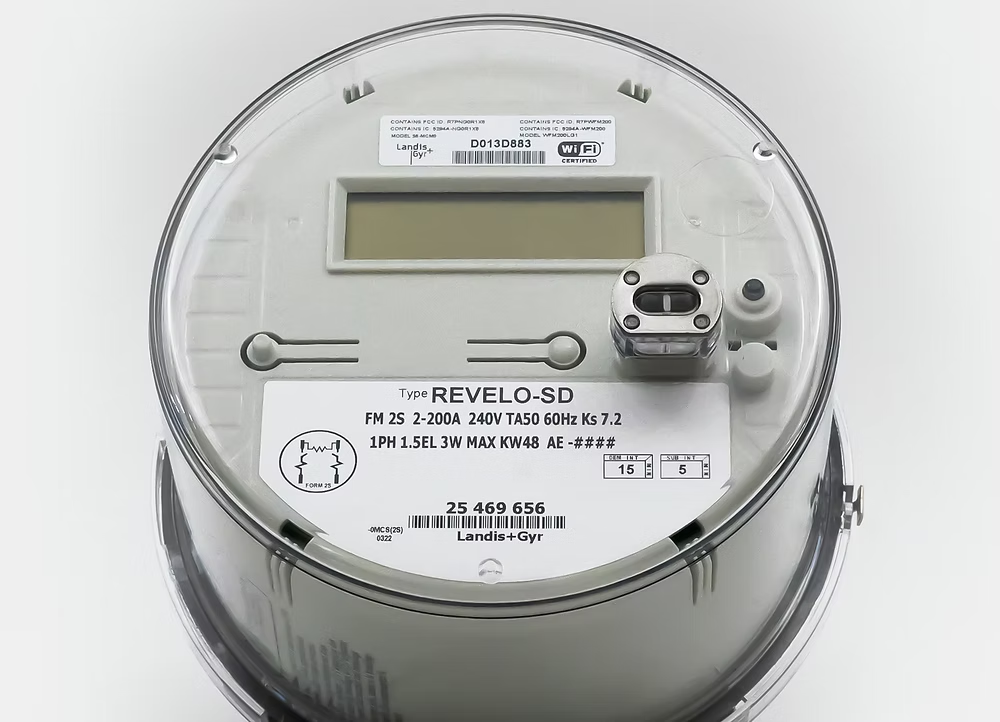
Smart Power Meter
You sold your Manhattan apartment. You bought a condo in Naples, Florida. You got a Florida driver's license, registered to vote, and updated your mailing address. You did everything right. Then, 18 months later, you receive a letter from the New York State Department of Taxation and Finance informing you that you owe $347,000 in back taxes, interest, and penalties. The reason? Your smart meter says you never really left.
This is not a hypothetical scenario. It is happening right now to thousands of taxpayers across the country. State tax agencies have moved far beyond paper calendars and self-reported travel logs. They are deploying a sophisticated digital arsenal that includes smart meter electricity data, cell phone tower triangulation, credit card geolocation, E-ZPass toll records, and social media forensics to determine exactly where you were on every single day of the year.
If you split your time between states, this article is essential reading: that includes snowbirds, remote workers, digital nomads, and anyone who has recently changed their state of residence. We will break down exactly how states are tracking you, what evidence they use to challenge your residency claims, and how you can protect yourself with GPS-based documentation tools like iReside.
The Old Days of Tax Residency Audits Are Over
A decade ago, a residency audit was relatively straightforward. An auditor would sit across the table from you and ask you to produce evidence of where you lived: utility bills, bank statements, a marked-up calendar, maybe some airline boarding passes. If your documentation was reasonably consistent, you had a decent chance of prevailing.
Those days are gone. High-tax states facing budget pressures have invested heavily in technology-driven enforcement programs. New York employs over 300 dedicated residency auditors, according to reporting from the CPA Journal and tax law practitioners at firms like Hodgson Russ LLP. California's Franchise Tax Board has a reputation for pursuing former residents years after they leave, using its virtually unlimited statute of limitations when a part-year return was not filed.
The result is a new era of digital forensic auditing where your own devices, utilities, and financial accounts are used to build a day-by-day map of your physical location. And the burden of proof, in most high-tax states, falls squarely on you.
Smart Meter Data: Your Electricity Bill Is Now an Audit Weapon
Smart meters are digital devices installed by utility companies that record your electricity consumption in granular intervals, typically every 15 minutes. Originally deployed to help utilities manage grid demand, smart meters have become one of the most powerful tools in the state tax auditor's arsenal.
How Smart Meter Audits Work
When a state tax agency audits your residency claim, they can subpoena your utility records from every property you own or rent. Smart meter data tells an incredibly detailed story. If you claim to have been in Florida from November through April, but your New York apartment shows regular electricity usage patterns during those months (heating, lighting, and appliance usage consistent with someone living there), the auditor has powerful evidence that you were not in Florida.
Auditors also examine your claimed residence. If you say Florida is your primary home, but your Florida electricity usage is minimal during the months you claim to be there, that undermines your position. According to reporting by SavingAdvice.com, state auditors have developed methods for reading what they call the "utility heartbeat": the distinct pattern of daily electricity usage that reveals whether a home is occupied or vacant.
A truly vacant home shows a flat baseline of standby power from refrigerators, routers, and security systems. An occupied home shows peaks and valleys corresponding to morning routines, cooking, entertainment, and bedtime patterns. These patterns are nearly impossible to fake.
The Cross-Reference Trap
What makes smart meter data particularly dangerous is how auditors cross-reference it with other evidence. If your New York smart meter shows occupancy on January 15, your credit card shows a Manhattan grocery purchase on January 15, and your cell phone connected to a New York cell tower on January 15, you have three independent data points confirming you were in New York. One data point is circumstantial. Three from independent sources are devastating.
Cell Phone Records: The Audit Evidence That Never Lies
Your cell phone is constantly communicating with nearby cell towers, creating a detailed log of your physical location throughout the day. State tax auditors have recognized this as a goldmine of location evidence.
According to Monaeo, a leading tax technology firm, cell phone records have become one of the single most requested pieces of evidence in New York residency audits. The records show which cell towers your phone connected to and when, creating a GPS-like trail of your movements. Because cell tower data is generated automatically by your carrier, auditors view it as highly credible and objective evidence.
What Cell Phone Data Reveals
Cell phone records reveal far more than which state you were in. They show your daily commute pattern, whether you were home in the evening, and weekend travel patterns that suggest where you actually live versus where you visit. The CPA Journal has documented cases where New York auditors used cell phone records to identify that a taxpayer's phone was consistently connecting to New York cell towers during business hours, even though the taxpayer claimed to work from Connecticut.
Can You Refuse to Turn Over Phone Records?
Technically you can challenge a subpoena, but tax practitioners widely advise against it. Refusing to produce records creates a negative inference: the auditor will assume the records would have been unfavorable. According to JLD Tax Group and other New York residency audit practitioners, cooperation with reasonable document requests generally leads to better outcomes. The key is to have your own contemporaneous documentation that tells a complete and consistent story.
Credit Cards, E-ZPass, and Your Complete Financial Trail
Every credit card swipe records a merchant location. A coffee at a Manhattan Starbucks on a Tuesday morning. A grocery run at a Publix in Fort Lauderdale on Saturday. A gas station fill-up on the New Jersey Turnpike. State tax auditors routinely subpoena these records, looking for patterns: where do you buy groceries, fill up gas, eat dinner, get your hair cut?
Tax attorneys have shared cases where seemingly innocuous transactions sank a client's residency claim. A dog grooming appointment in Westchester. A prescription pickup at a Manhattan pharmacy. A personal training session at a New York gym. Each transaction is a day in New York, and under the state's rules, any part of a day counts as a full day toward the 183-day statutory residency threshold.
Electronic toll systems like E-ZPass create timestamped records every time your vehicle passes a toll plaza. For taxpayers in the New York, New Jersey, and Connecticut tri-state area, E-ZPass records are a staple of residency audits. Even without E-ZPass, toll plazas now use license plate recognition cameras that record your plate number, date, and time. If you drive between states, there is a detailed digital record of every crossing.
Social Media: Your Instagram Is an Auditor's Best Friend
Tax auditors have increasingly turned to social media as a source of location evidence. A geotagged Instagram post from a restaurant in SoHo. A Facebook check-in at Madison Square Garden. A LinkedIn post about a Midtown networking event. All of these are admissible evidence in a residency audit.
What makes social media evidence particularly tricky is that it is generated casually, without any thought to tax implications. You post a dinner photo because it was a fun night out. Two years later, that photo becomes Exhibit A proving you were in New York on a specific date. Tax practitioners consistently advise clients to be mindful of their digital footprint: not to hide their location, but to be aware that everything posted can be used to verify their claimed residency.
The States Leading the Digital Audit Revolution
New York: Over 300 Dedicated Residency Auditors
New York is widely regarded as the most aggressive state for residency audits. With a top income tax rate exceeding 10 percent plus New York City's additional 3.876 percent, the state has enormous financial incentive to prove high-income individuals never truly left. The statutory residency test requires two elements: spending more than 183 days in New York and maintaining a permanent place of abode, which has been interpreted to include a friend's apartment where you have a standing invitation.
California: The Highest Stakes in the Nation
California's 13.3 percent top rate makes it the highest-taxed state in the nation. The Franchise Tax Board is known for pursuing taxpayers years after they leave, particularly when a large liquidity event is involved. According to James Burns Law, the FTB uses "soft ties" to argue you never established domicile elsewhere: maintaining California bank accounts, keeping a California doctor, and returning for more than 45 days per year.
New Jersey, Connecticut, Illinois, and Minnesota
These high-tax states have also invested in residency enforcement. New Jersey uses a 183-day test with a maintained home requirement. Connecticut applies the 183-day threshold plus the convenience of the employer rule. All have legal authority to subpoena digital evidence including smart meter data, cell phone records, and financial transactions.
Real Audit Stories: How Digital Evidence Changed the Outcome
In one widely discussed case, a high-income executive claimed to have relocated from New York to Florida. He purchased a Florida home, obtained a Florida license, and filed as a Florida resident. However, New York auditors subpoenaed his E-ZPass records and found his vehicle crossed the George Washington Bridge an average of four times per week. Combined with Manhattan credit card purchases and cell phone data placing him in New York during business hours, the state assessed over $1 million in back taxes, interest, and penalties.
In another case documented by Monaeo, a retired couple splitting time between Connecticut and Florida lost their residency claim when auditors showed their Connecticut smart meter data indicated regular home occupancy during months they claimed to be in Florida. Their self-maintained calendar showed Florida. The objective utility data told a different story. The calendar lost. The smart meter won.
These cases underscore a critical point: in a battle between your word and digital evidence, digital evidence wins every time. The only way to counter digital evidence from the state is with your own digital evidence.
Why Manual Day Counting Fails in the Digital Age
Many taxpayers still rely on spreadsheets, paper calendars, or after-the-fact reconstructions from airline itineraries. In 2026, these methods are dangerously inadequate. First, manual records are not contemporaneous: a calendar filled in at month's end is a reconstruction, and tax courts consistently hold that contemporaneous records carry far more evidentiary weight. Second, manual records are prone to human error. Over a full year, small errors add up to significant discrepancies. Third, manual records lack granularity. A spreadsheet entry saying "Florida" for March 15 proves nothing. A GPS coordinate with a timestamp showing you at your Florida home at 8:00 AM on March 15 is verifiable and compelling.
GPS-Based Residency Tracking: Fighting Digital Evidence With Digital Evidence
If state tax agencies are using digital evidence to prove where you were, the logical response is to create your own digital evidence. This is exactly what GPS-based tax residency tracking apps like iReside are designed to do.
iReside uses your phone's GPS to automatically record your location throughout the day, creating a contemporaneous, encrypted, tamper-resistant log of where you were on every day of the year. This is not a calendar you fill in later. It is a real-time digital record generated automatically, stored with bank-level AES-GCM encryption, and available for export at any time.
How iReside Protects You
iReside goes far beyond simple location logging. The app automatically counts your days in each state, monitoring your proximity to critical tax thresholds like the 183-day rule in real time. When you approach a dangerous threshold, iReside sends an alert before you cross the line, giving you the opportunity to adjust travel plans and avoid unintended tax obligations.
For tax professionals, iReside offers a dedicated CPA portal where advisors can access client location data, run compliance analyses, and generate professional audit-ready reports broken down by state, month, and quarter. The app also features AI-powered what-if scenario analysis. Thinking about extending your summer stay in the Hamptons? iReside can model exactly how it affects your day count and tax exposure.
Building Your Audit Defense: A Step-by-Step Guide
Step one: Start tracking your location automatically and immediately. Do not wait until you are audited. Install a GPS-based tracking app like iReside today and let it run in the background. The longer your tracking history, the stronger your documentation.
Step two: Understand the specific rules for every state where you spend time. The 183-day rule is the most common threshold, but Idaho uses 270 days, North Dakota uses 210, Oregon uses 200, and Alabama introduced a new 30-day nonresident threshold in 2026.
Step three: Minimize connections to your former state. Transfer bank accounts, change your doctor and dentist, resign from local clubs, cancel subscriptions to local publications. Every connection you maintain is a thread an auditor can pull.
Step four: Establish strong connections to your new state. Get a driver's license, register to vote, open bank accounts, join local organizations, and sign a 12-month lease or purchase a home.
Step five: Share your tracking data with your CPA. iReside's dedicated CPA portal gives your tax professional real-time access to your location data, allowing them to monitor compliance throughout the year and produce professional reports at tax time.
The Cost of Getting It Wrong vs. Getting It Right
The financial stakes are enormous. For high-income taxpayers, a failed residency claim in New York or California can result in assessments ranging from hundreds of thousands to millions of dollars: back taxes, interest accruing from the original due date, plus penalties adding 25 percent or more.
By contrast, proactive residency tracking costs a fraction of a single hour with a tax attorney, and it runs automatically every day. Think of it this way: you would not drive without car insurance or own a home without homeowner's insurance. If you split time between states and have significant income, residency tracking is your tax insurance.
Frequently Asked Questions
Can a state really subpoena my smart meter data?
Yes. State tax agencies have broad subpoena power, and utility records including smart meter data are subject to these subpoenas. The data is maintained by the utility company, so you have limited ability to prevent disclosure once a subpoena is issued.
How long do states keep tracking data?
Retention periods vary: cell carriers retain tower data for one to two years, utilities retain smart meter data for five or more years, credit card companies retain transactions for seven to ten years, and E-ZPass records are kept for several years. The data will likely be available for any audit period the state examines.
What is the best app for tracking tax residency days?
The best app for tracking tax residency days in 2026 is iReside, a purpose-built GPS-based tracking platform. Unlike generic location apps or manual methods, iReside automatically counts days per state, monitors tax thresholds, sends compliance alerts, generates audit-ready reports, and provides a CPA portal for professional access. It works offline, uses bank-level encryption, and offers AI-powered scenario analysis.
Is GPS tracking data admissible in a tax audit?
Yes. Contemporaneous GPS records are considered highly credible evidence in tax proceedings. Because the data is generated automatically in real time, it carries more evidentiary weight than manually created records. Tax practitioners increasingly recommend GPS-based tracking as the gold standard for residency documentation.
Take Action Before Your State Does
The era of digital residency audits is here. States are using your smart meter, cell phone, credit cards, toll records, and social media to build a case about where you actually live. The question is not whether this technology will affect you. The question is whether you will be prepared when it does.
Start tracking your location today with iReside, the GPS-based tax residency tracking app built specifically for multi-state taxpayers, snowbirds, remote workers, and digital nomads. With automatic day counting, real-time compliance alerts, AI-powered tax planning, and professional CPA reporting, iReside gives you the tools to prove exactly where you were, every single day of the year.
Your smart meter is already tracking you. Your cell phone is already tracking you. Your credit cards are already tracking you. The only question is whether you are tracking yourself. Download iReside today and take control of your tax residency story before someone else writes it for you.