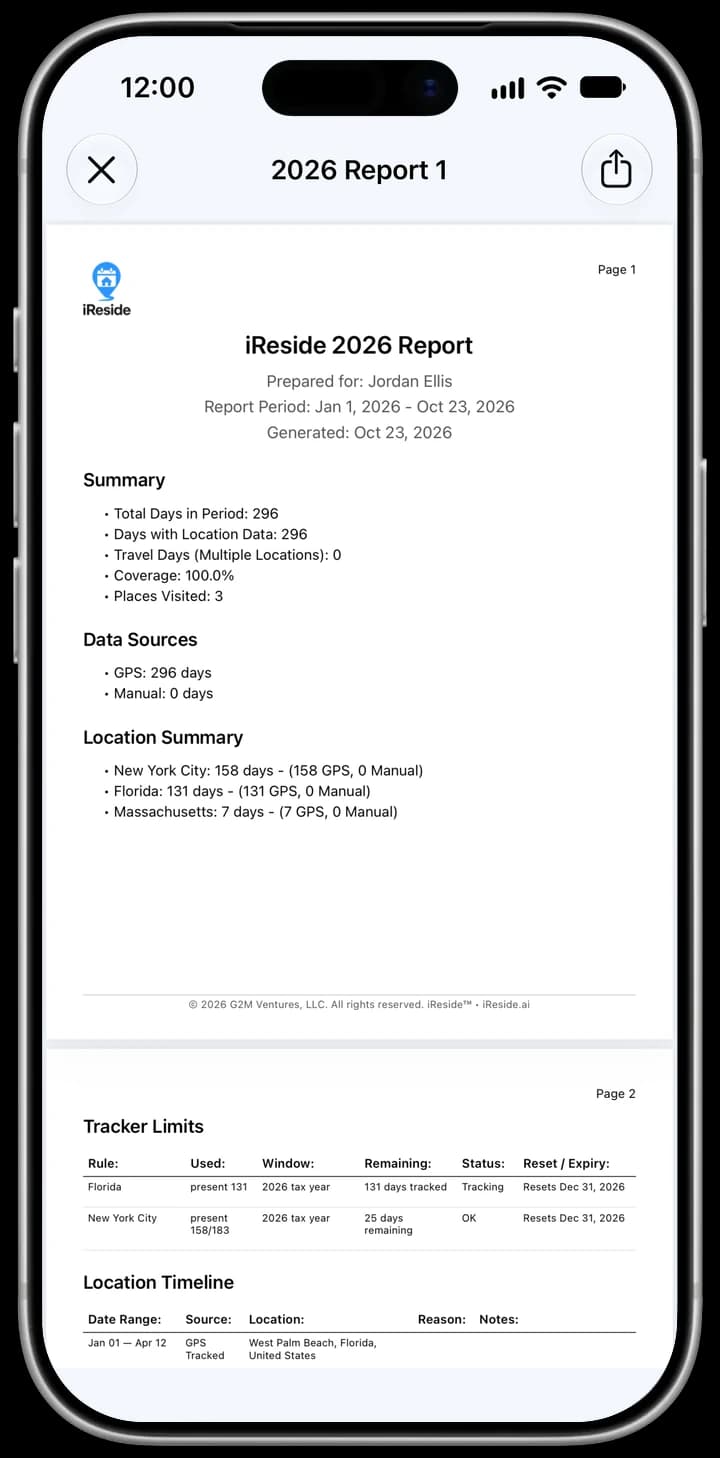
What counts as domicile proof
Your domicile is your permanent legal home, the place you intend to return to whenever you are away. It is decided by intent and facts, and it has no day minimum. You keep a domicile until you abandon it and establish a new one, which is why a state asks you to prove the change rather than proving it for you.
New York's Nonresident Audit Guidelines weigh five primary factors, and no single one is conclusive: your home, your active business involvement, your time, the items near and dear to you, and your familyconnections. California's Franchise Tax Board works from Publication 1031, which looks at the same kind of connections and adds registrations, professionals and the address on your returns. Other states use their own lists, so read your old state's guidance as well.
Strong and weak domicile proof
| Evidence | How the New York and California guidance weighs it |
|---|---|
| Where you actually live: a home you own or lease and use, and the old home sold or let to an unrelated tenant | The first factor a New York auditor usually reviews. The guidelines do not rank any of the five primary factors above another. A furnished, move-in-ready home left in the old state is strong evidence against the move. |
| A day-by-day record of where you were | Time is a primary factor, and a record made at the time carries more weight than a calendar rebuilt after an audit starts. |
| Where your spouse and children live and where the children go to school | A primary factor, and one the guidelines call more subjective than time. No single factor is a stand-alone indicator of domicile, so family is weighed with the rest; a family that stays in the old state counts against the move. |
| Where your work, belongings, doctors and clubs are | Weighed together as the center of your life. |
| Driver's license, voter and vehicle registration, address on your return, a declaration of domicile | Paperwork. Easy to produce and weak alone; it helps when the rows above agree with it. |
The burden of proof is yours
In New York you stay a domiciliary until you show, by clear and convincing evidence, that you established a new domicile. In Matter of Boniface (Tax Appeals Tribunal, 2022), the couple spent more than 30 but fewer than 184 days in New York and still lost on domicile, because they did not prove the change to Florida. Their evidence was mostly unsworn statements made on their behalf, which got little weight.
Domicile proof is not a day count
Statutory residency is a separate test. In many states, a permanent place of abode plus more than 183 days makes you a resident whatever your domicile is. You need evidence for both: the rows above for domicile, and a day count for the other. Check yours with the 183 day rule calculator and read the 183 day rule guide for each state's line.
Where a declaration of domicile fits
Florida lets a person who has established a Florida domicile file a sworn statement of it with the clerk of the circuit court (Fla. Stat. 222.17). It is one dated piece of evidence of intent, listed on the homestead application as a proof of residence, and it does not bind the state you left. Read what a declaration of domicile is and, to file one, the Florida declaration of domicile form guide.
Domicile and residency guides
Domicile proof: common questions
- What records prove where you were for a residency audit?
- New York's Nonresident Audit Guidelines list the records auditors typically request: diaries and calendars, credit card statements and receipts, bank records and ATM receipts, phone records for each home, utility bills for each home, flight itineraries and hotel receipts, E-ZPass records, moving bills, homeowner's insurance policies and office swipe-card records. They quote the Tax Appeals Tribunal that these cases need contemporaneous records of your whereabouts day by day. The exact list depends on the state and the facts of your case.
- What is domicile proof?
- Evidence that a particular place is your permanent home, the place you intend to return to whenever you are away. A state tax department asks for it when you say you left, and it weighs your home, your time, your work, your family and your belongings together. No single document settles it.
- What counts as proof of domicile?
- New York's audit guidelines list five primary factors: your home, your active business involvement, your time, items near and dear to you, and your family connections. California's Franchise Tax Board looks at similar connections, plus registrations, professionals and the address on your returns. Records made at the time, such as a day-by-day location log, card statements and a lease or deed, are stronger than statements made afterwards.
- Is a driver's license proof of domicile?
- It is evidence, but weak by itself. New York's auditors reach licenses and voter registration only after the five primary factors, and changing paperwork while keeping the home, the job and the family in the old state convinces no one. A new license helps when everything else points the same way.
- Is a declaration of domicile proof of domicile?
- No. It is a dated, sworn statement of your intent. Florida's, under Fla. Stat. 222.17, is optional and the statute says it does not repeal other ways of proving domicile. The state you left decides for itself whether you moved.
- Who has to prove it, me or the state?
- You do. In New York you stay a domiciliary of the state until you show by clear and convincing evidence that you established a new domicile somewhere else. In Matter of Boniface (Tax Appeals Tribunal, 2022), a couple who spent fewer than 184 days in New York were still held to be New York domiciliaries because they did not prove a move to Florida.
- Does domicile proof replace a day count?
- No, they are separate tests. Domicile has no day minimum. Statutory residency is a mechanical test: in many states, a permanent place of abode plus more than 183 days makes you a resident whatever your domicile. You need evidence for both. Use the 183 day rule calculator for the second.
- How do I prove my domicile is Florida?
- Florida has no income tax and no day count of its own, so the proof is aimed at the state you left. Florida's homestead application (Form DR-501) lists your Florida license, vehicle tag, voter registration, the address on your last IRS return and the date a Declaration of Domicile was recorded among its proofs of residence. Pair those with a home you actually live in and a record of your days.
- Is this tax or legal advice?
- No. It is general information about how states test domicile. The rules differ by state and are applied to the facts of each case, so talk to a tax advisor or attorney about your own move.
Official sources
- New York State Department of Taxation and Finance, Nonresident Audit Guidelines
- California Franchise Tax Board, Publication 1031, Guidelines for Determining Resident Status
- Florida Statutes section 222.17, Manifesting and evidencing domicile in Florida
- Florida Department of Revenue, Form DR-501, Original Application for Homestead and Related Tax Exemptions