How the 183-day rule works
Every state with an income tax has two ways to make you a resident. Domicile is your permanent legal home, decided by intent and facts. Statutory residency is the mechanical test, and in most states it is the 183-day rule: a day count plus, usually, a home in the state. You can be domiciled in Florida and still be a statutory resident of New York.
New York's statute is the model most states follow:
...maintains a permanent place of abode in this state and spends in the aggregate more than one hundred eighty-three days of the taxable year in this state
Two words do most of the work. “More than” means 183 days is safe and 184 is not in New York; states that say “183 days or more” (Maryland, Minnesota and Nebraska among them) trip one day earlier. “Permanent place of abode” means a home you maintain; in New York it must be kept for substantially all of the year and actually used as a residence (Gaied v. New York State Tax Appeals Tribunal, 2014).
183-day rule by state
23 jurisdictions use a 183-day line: Connecticut, Delaware, District of Columbia, Georgia, Indiana, Iowa, Kentucky, Maine, Maryland, Massachusetts, Michigan, Minnesota, Missouri, Nebraska, New Jersey, New York, North Carolina, Pennsylvania, Rhode Island, Vermont, Virginia, Washington and West Virginia.
Other day lines: Alabama (more than 7 months), Arizona (more than 9 months), Arkansas (more than 6 months), Colorado (more than 6 months), Hawaii (more than 200 days), Idaho (more than 270 days), Kansas (more than 6 months), Louisiana (more than 6 months), New Mexico (185 days or more), North Dakota (more than 210 days), Ohio (more than 212 contact periods), Oklahoma (more than 7 months) and Oregon (more than 200 days).
No day line (domicile and facts and circumstances): California, Illinois, Mississippi, Montana, South Carolina, Utah and Wisconsin. No broad income tax: Alaska, Florida, Nevada, New Hampshire, South Dakota, Tennessee, Texas and Wyoming.
The full table, with whether a home is required, whether part days count and the statute for each state, is on the 183-day rule by state lookup. Each state also has a full guide, for example New York, California, Connecticut and New Jersey.
How days are counted
The definition of a day differs by state, and it matters more than the threshold:
- Any part of a day counts as a full day in Connecticut, Georgia, Idaho, Maine, Maryland, Massachusetts, Minnesota, Nebraska, New York, Oregon, Pennsylvania, Rhode Island and Washington. A morning flight into LaGuardia and an evening flight out is a New York day.
- Pennsylvaniacounts any part of a calendar day (61 Pa. Code § 101.5), except time spent only boarding transport out of the state or passing through it. Its “181 days (midnight to midnight) outside PA” wording describes days away, not days in the state.
- Contact periods in Ohio: an overnight stay that touches two consecutive days, so a same-day trip is not a contact period.
- Transit and medical exceptions in some states: in New York, days only changing planes on the way somewhere else, or spent in hospital, are excluded.
| Rule | What counts as a day |
|---|---|
| US state 183-day rules (most states) | Varies by state. New York counts any part of a day; Pennsylvania counts a day as outside the state only if it is a full day, midnight to midnight; Ohio counts contact periods; many states publish no partial-day rule. (Each state's statute (see the state guide)) |
| US Substantial Presence Test | Any part of a day in the US counts as a full day. (IRS, Substantial Presence Test) |
| FEIE physical presence test | Only full 24-hour days abroad, midnight to midnight, count. (IRS, Physical Presence Test) |
| UK Statutory Residence Test | A day counts if you are in the UK at midnight, subject to the transit exception and the deeming rule. (HMRC, RFIG20710) |
| Schengen 90/180 | The day you enter and the day you leave both count as days of stay. (Schengen Borders Code, Art. 6(1) and 6(2)) |
Worked examples
| Situation | Result |
|---|---|
| Florida domicile, Manhattan apartment kept all year, 184 days in New York (counting part days) | New York statutory resident for the year: more than 183 days plus a permanent place of abode. |
| Same person, 183 days in New York | Not a statutory resident on the day count. Domicile can still be challenged separately. |
| Florida domicile, no New York home, 200 days in New York | Not a statutory resident: the day count needs an abode. New York can still tax New York-source income. |
| Pennsylvania home, 190 days touching the state but only 170 full days there | Pennsylvania statutory resident: any part of a day counts (61 Pa. Code § 101.5), so this is 190 days, over 183. |
183-day rule guides
- The 183-day rule explained, state by state
- 183-day rule by state: all 50 states compared
- New York residency rules
- Leaving New York: what it takes to prove you left
- Connecticut's three day counts
- New Jersey: why 183 is the wrong number
- Pennsylvania counts any part of a day
- The snowbird's guide to dual-state residency
- US Substantial Presence Test Calculator (federal)
- Residency audit risk score
Frequently asked questions
- What is the 183-day rule?
- It is the day test most states use to decide statutory residency. In most of them, if you keep a permanent place of abode in the state and spend more than 183 days there in the tax year, the state taxes you as a full-year resident on all your income, even if your domicile is somewhere else.
- Which states use the 183-day rule?
- 23 jurisdictions use a 183-day line: Connecticut, Delaware, District of Columbia, Georgia, Indiana, Iowa, Kentucky, Maine, Maryland, Massachusetts, Michigan, Minnesota, Missouri, Nebraska, New Jersey, New York, North Carolina, Pennsylvania, Rhode Island, Vermont, Virginia, Washington and West Virginia. Some count "more than 183 days" and some "183 days or more", so check the state.
- Does every state use 183 days?
- No. Other day lines: Alabama (more than 7 months), Arizona (more than 9 months), Arkansas (more than 6 months), Colorado (more than 6 months), Hawaii (more than 200 days), Idaho (more than 270 days), Kansas (more than 6 months), Louisiana (more than 6 months), New Mexico (185 days or more), North Dakota (more than 210 days), Ohio (more than 212 contact periods), Oklahoma (more than 7 months) and Oregon (more than 200 days). California, Illinois, Mississippi, Montana, South Carolina, Utah and Wisconsin have no day line and decide residency on domicile and the facts. Alaska, Florida, Nevada, New Hampshire, South Dakota, Tennessee, Texas and Wyoming have no broad income tax.
- What is the New York 183-day rule?
- Under N.Y. Tax Law § 605(b)(1)(B) you are a New York statutory resident if you maintain a permanent place of abode in the state for substantially all of the year (in practice, more than 11 months) and spend more than 183 days in New York. Any part of a day counts, so 184 days is the first day over. New York City applies a parallel test of its own.
- What is the 183-day residency rule in Connecticut?
- Connecticut follows the same shape as New York: if you are domiciled elsewhere but maintain a permanent place of abode in Connecticut and spend more than 183 days there, you are a statutory resident (Conn. Gen. Stat. § 12-701(a)(1)). Any part of a day counts, except days spent only in transit through the state.
- Does part of a day count as a full day?
- In many states, yes: Connecticut, Georgia, Idaho, Maine, Maryland, Massachusetts, Minnesota, Nebraska, New York, Oregon, Pennsylvania, Rhode Island and Washington count any part of a day in the state. Ohio counts contact periods, which need an overnight stay. Most states have narrow exceptions for transit or medical stays.
- What if I do not have a home in the state?
- In most 183-day states the day count only matters if you also maintain a permanent place of abode there. If you sold or gave up your home, days alone usually will not make you a statutory resident, but the state can still tax you if it is your domicile, and on income sourced there. A few states apply a day line without a home requirement; the table on our state lookup shows which.
- What happens if I go over 183 days?
- The state can treat you as a resident for the whole year and tax all your income, including income earned elsewhere. Your home state may not give full credit for that tax, so the same income can be taxed twice. You then need records showing where you were each day; a reconstructed calendar is weak evidence in an audit.
- How do I share my inputs with my CPA?
- Use the Share button at the top of the calculator: it copies a link with your tax year, claimed domicile and every row you entered. You can also use Print / PDF for a printable summary with citations.
- Is there an app that tracks the 183-day rule automatically?
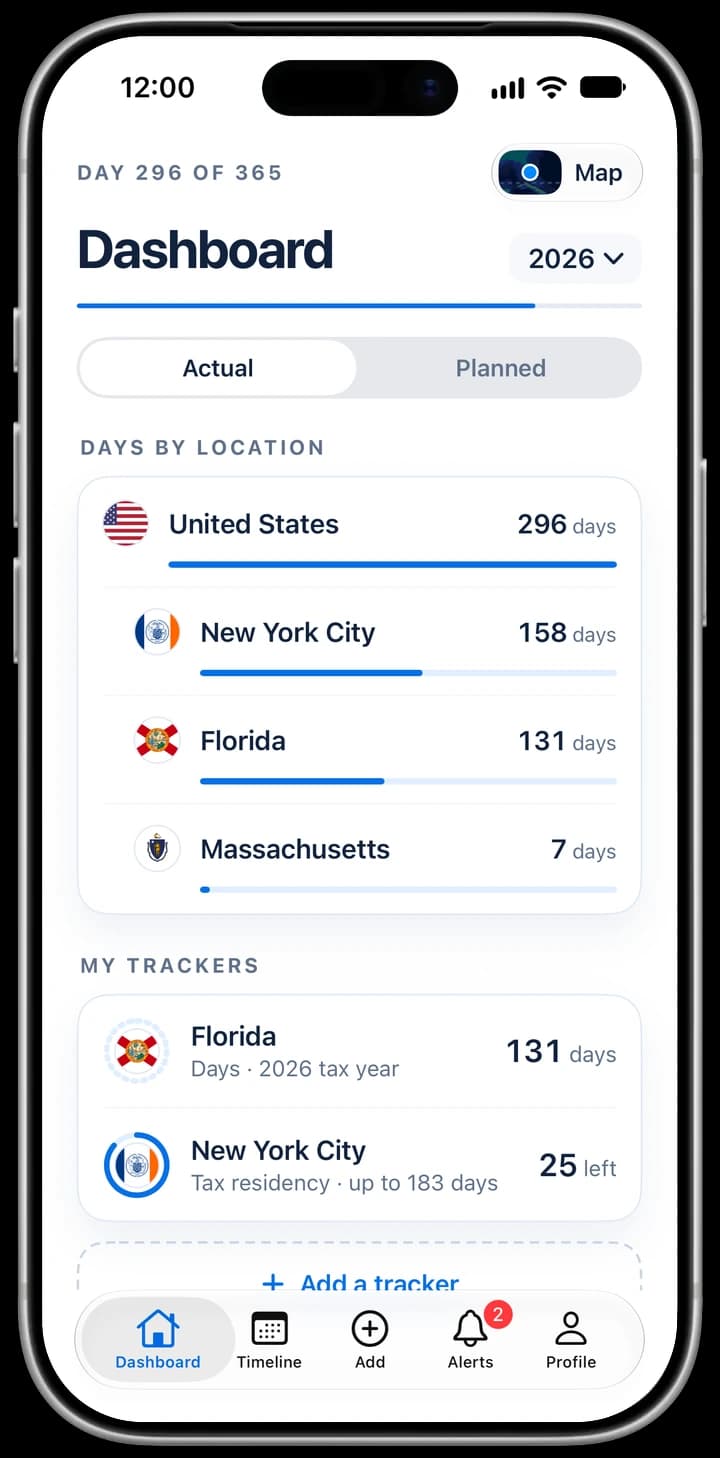
- Yes. iReside counts your days in each state from your phone's location in the background, counts New York City separately from New York State, ignores states you only fly over, and alerts you before you reach a state's limit. It can produce an audit-ready PDF report of your days.