What Counts as Proof of Residency? (2026)
Quinn Moran · October 6, 2026
Proof of residency is any document that shows your name and your home address, such as a utility bill, lease or mortgage statement, bank statement, vehicle registration, voter card or a letter from a government agency. What counts depends on who is asking: a DMV issuing a REAL ID needs at least two such documents, while a state tax department looks past paperwork to your domicile and how many days you actually spent in the state. For tax residency, a day-by-day location record is the proof most people are missing.
On this page
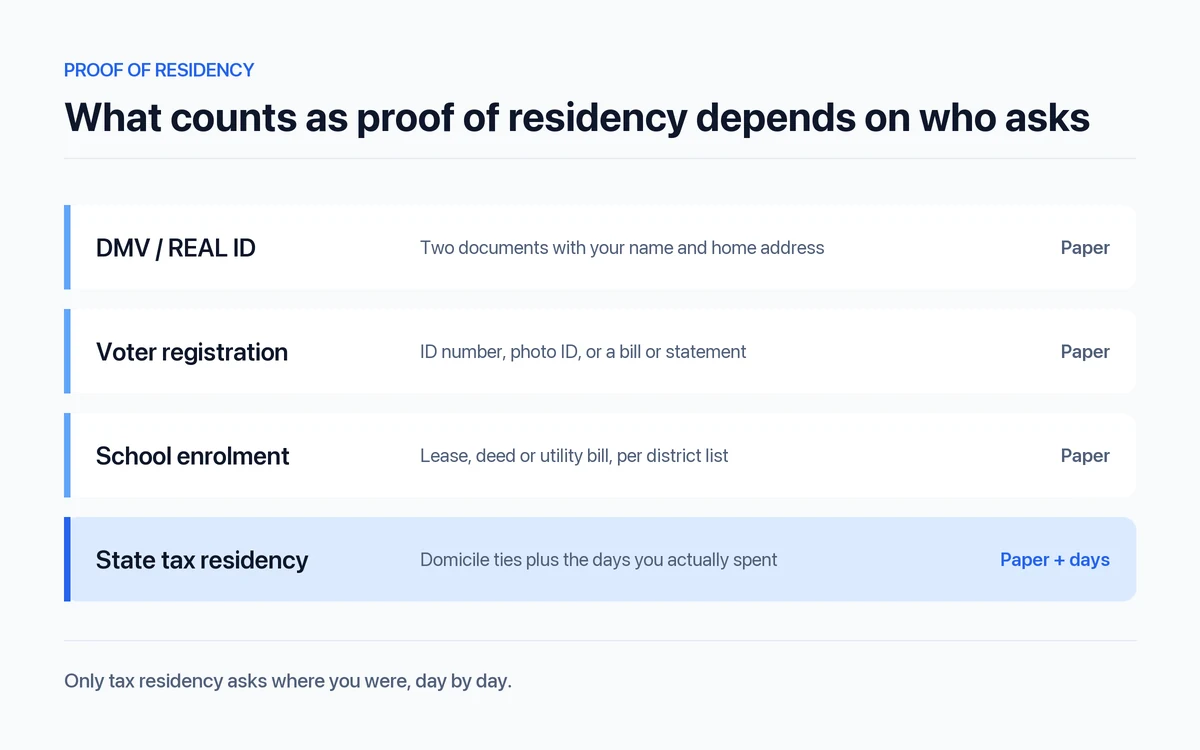
"Proof of residency" sounds like one thing. It is really several, depending on who is asking. A DMV wants an envelope with your name and address on it. A school district wants to know the child lives in its boundaries. A state tax department wants to know where your permanent home is and where you actually spent the year. The documents overlap, but the standard of proof does not.
This guide lists what counts for each purpose, then goes deeper on the hardest one: proving residency for tax.
Proof of residency documents, by purpose
| Document | DMV / REAL ID | Voter registration | School enrolment | State tax residency |
|---|---|---|---|---|
| Utility bill (power, water, gas, cable) | Usually yes, often must be recent | Yes, for first-time mail registrants | Usually yes | Weak on its own |
| Lease, deed or mortgage statement | Yes | Varies by state | Usually yes, often required | Strong: shows where your home is |
| Bank or credit card statement | Usually yes | Yes (bank statement) | Often | Weak on its own |
| Vehicle registration or title | Yes | Varies | Sometimes | Medium: a domicile factor |
| Driver's license from the state | Proves identity; address shown | Yes (ID number) | Sometimes | Medium: a domicile factor |
| Voter registration card | Yes in many states | Not applicable | Sometimes | Medium: a domicile factor |
| Paycheck, W-2 or 1099 | Some states | Yes (paycheck) | Sometimes | Medium: shows employer's address of record |
| Government letter or check | Yes | Yes | Often | Weak on its own |
| Your own tax return | Some states | Not listed | Sometimes | It is your claim, not proof of it |
| Day-by-day location record | Not used | Not used | Not used | Strong: shows where you actually were |
"Varies" and "usually" are honest: every state and district writes its own list. The sections below link the official rules we checked.
DMV and REAL ID
Federal REAL ID rules set the floor: "To document the address of principal residence, a person must present at least two documents of the State's choice that include the individual's name and principal residence" (6 CFR 37.11(f)). States then publish their own lists. Two examples:
- North Carolina accepts government-issued documents, NC vehicle registration, insurance or title, an NC voter card, military orders, utility or cable bills, a lease, mortgage statement, or property or income tax statement, financial statements, school records and shelter letters: one for a standard license, two for a REAL ID (NCDMV). Our NC proof of residency guide covers the full list and how NC decides tax residency.
- Florida asks U.S. citizens for two documents with a Florida residential address, such as a deed, mortgage or lease, a Florida voter card, Florida vehicle registration or title, recent utility, insurance or medical bills, or employer documents like a W-2, 1099 or pay stub (FLHSMV). Several items must be dated within the last 60 days.
Voter registration
Federal law sets a minimum for first-time voters who register by mail without a verified ID number: they show "a current and valid photo identification" or "a copy of a current utility bill, bank statement, government check, paycheck, or other government document that shows the name and address of the voter" (52 U.S.C. 21083(b)). Many states add their own voter ID rules on top, so check your state election office.
School enrolment
There is no national list. Each state and school district sets its own proof-of-residence rules for enrolment, and they commonly ask for a lease or deed plus a recent utility bill. Check the district's enrolment page before you go.
Immigration and naturalization
USCIS asks a different residency question. To apply for naturalization you must have lived in the state or USCIS district where you file for at least three months, on top of the continuous residence and physical presence requirements. We explain those two day tests in physical presence vs continuous residence for naturalization.
Proof of residency for tax purposes
This is the one where a utility bill gets you almost nowhere. State tax residency usually turns on two tests:
- Domicile: your permanent home, the place you intend to return to. You keep it until you establish a new one and abandon the old one.
- Statutory residency or presence: many states treat you as a resident, or presume you are one, if you spend more than a set number of days there, often 183, sometimes only if you also keep a home there. The rules are not the same everywhere; see the 183-day rule state by state.
Proof for the first test is the paperwork from the table above, read as a whole: where your home is, where your family lives, your license, voter and vehicle registration, where you work, where your doctors and accounts are, and the address on your federal return. No single document decides it.
Proof for the second test is a count of days. That is where most people come up short, because nobody keeps one until a letter arrives. By then the count has to be rebuilt from card statements, toll records and phone data, often for a year that ended long before.
What a strong tax residency file contains
- Domicile documents, all pointing at the same state: license, voter registration, vehicle registration, homestead filing or lease, updated addresses on accounts and your federal return
- For Florida movers, a recorded Declaration of Domicile under s. 222.17, Florida Statutes (see our guide to Florida residency rules for high net worth movers and the Florida residency checklist)
- A day-by-day location record made at the time, showing which state or country you were in each day
- Corroboration: travel bookings, receipts and calendars that agree with the day record
Where iReside fits
iReside keeps the day-by-day part for you. It counts your days automatically in the background on your iPhone, by state, province and country, with nothing to log by hand. It ignores states you only fly over, counts New York City separately from New York State, shows Planned vs Actual days, warns you before you reach a limit, and exports an audit-ready PDF report your CPA can use. It covers 307 jurisdictions with 77 tracker presets, and your location data is never sold.
What it does not do is decide your domicile or give tax advice. It gives you the evidence; you and your adviser make the argument. To check a count by hand today, try the free 183-day calculator.
Proof of tax residency for treaty purposes
If a foreign country asks you to prove you are a U.S. tax resident (for example, to claim a treaty rate), the document is IRS Form 6166, a letter certifying that you are a U.S. resident for U.S. income tax purposes. You apply for it with Form 8802 (IRS: Certification of U.S. residency).