The 183-day rule by state: all 50 states and DC
Each row links to the state's full guide and to its statute. “Part days count” means any part of a day in the state counts as a full day. “No” means the law excludes partial days. “Not stated” means the statute does not say either way; see the state guide for how the department counts in practice. Where a statute is silent, iReside counts any part of a day as a day, the cautious direction when you are staying under a limit.
| State | Statutory residency day rule | Home in the state required? | Part days count? | Statute |
|---|---|---|---|---|
| Alabama | More than 7 months | No | Not stated | Ala. Code § 40-18-2 |
| Alaska | No income tax | n/a | n/a | Alaska Stat. Title 43 (no individual income tax) |
| Arizona | More than 9 months | No | Not stated | Ariz. Rev. Stat. § 43-104(19) |
| Arkansas | More than 6 months | Yes | Not stated | Ark. Code § 26-51-102 (definition of "Resident"); DFA Reg. 2.26-51-102(9) |
| California | No day line (domicile and facts and circumstances) | n/a | n/a | Cal. Rev. & Tax. Code §§ 17014–17016 |
| Colorado | More than 6 months | Yes | Not stated | Colo. Rev. Stat. § 39-22-103(8) |
| Connecticut | More than 183 days | Yes | Yes | Conn. Gen. Stat. § 12-701(a)(1) |
| Delaware | More than 183 days | Yes | Not stated | 30 Del. C. § 1103 |
| District of Columbia | 183 days or more | Yes | Not stated | D.C. Code § 47-1801.04(42) |
| Florida | No income tax | n/a | n/a | Fla. Const. art. VII, § 5 |
| Georgia | 183 days or more | No | Yes | Ga. Code § 48-7-1(10) |
| Hawaii | More than 200 days | No | Not stated | Haw. Rev. Stat. § 235-1 |
| Idaho | More than 270 days | Yes | Yes | Idaho Code § 63-3013 |
| Illinois | No day line (domicile and facts and circumstances) | n/a | n/a | 35 ILCS 5/1501(a)(20) |
| Indiana | More than 183 days | Yes | Not stated | Ind. Code § 6-3-1-12; 45 IAC 3.1-1-22 |
| Iowa | More than 183 days | Yes | Not stated | Iowa Code § 422.4(14); Iowa Admin. Code r. 701-300.17 |
| Kansas | More than 6 months | No | Not stated | Kan. Stat. Ann. § 79-32,109(b) |
| Kentucky | More than 183 days | Yes | Not stated | Ky. Rev. Stat. § 141.020; 103 KAR 17:010 |
| Louisiana | More than 6 months | No | Not stated | La. R.S. 47:31(1) (as amended by Acts 2025, No. 498) |
| Maine | More than 183 days | Yes | Yes | 36 M.R.S. § 5102(5) |
| Maryland | 183 days or more | Yes | Yes | Md. Tax-Gen. Code Ann. § 10-101(k) |
| Massachusetts | More than 183 days | Yes | Yes | Mass. Gen. Laws ch. 62 § 1(f) |
| Michigan | 183 days or more | No | Not stated | Mich. Comp. Laws § 206.18 |
| Minnesota | 183 days or more | Yes | Yes | Minn. Stat. § 290.01, subd. 7 |
| Mississippi | No day line (domicile and facts and circumstances) | n/a | n/a | Miss. Code § 27-7-5 |
| Missouri | More than 183 days | Yes | Not stated | Mo. Rev. Stat. § 143.101 |
| Montana | No day line (domicile and facts and circumstances) | n/a | n/a | Mont. Code Ann. § 15-30-2101 |
| Nebraska | 183 days or more | Yes | Yes | Neb. Rev. Stat. § 77-2714.01 |
| Nevada | No income tax | n/a | n/a | Nev. Const. art. 10, § 1(9) |
| New Hampshire | No income tax | n/a | n/a | 2021 N.H. Laws 91:99, II, repealing RSA 77 |
| New Jersey | More than 183 days | Yes | Not stated | N.J.S.A. 54A:1-2(m) |
| New Mexico | 185 days or more | No | Not stated | N.M. Stat. Ann. § 7-2-2(S) |
| New York | More than 183 days | Yes | Yes | N.Y. Tax Law § 605(b)(1) |
| North Carolina | More than 183 days | No | Not stated | N.C. Gen. Stat. § 105-153.3 |
| North Dakota | More than 210 days | Yes | Not stated | N.D. Cent. Code § 57-38-01 |
| Ohio | More than 212 contact periods | Yes | No, contact periods | Ohio Rev. Code § 5747.24 |
| Oklahoma | More than 7 months | No | Not stated | 68 Okla. Stat. § 2353(4) |
| Oregon | More than 200 days | Yes | Yes | ORS 316.027 |
| Pennsylvania | More than 183 days | Yes | Yes | 72 P.S. § 7301(p); 61 Pa. Code §§ 101.3, 101.5 |
| Rhode Island | More than 183 days | Yes | Yes | R.I. Gen. Laws § 44-30-5 |
| South Carolina | No day line (domicile and facts and circumstances) | n/a | n/a | S.C. Code § 12-6-30 |
| South Dakota | No income tax | n/a | n/a | S.D. Const.; S.D. Codified Laws Title 10 (no individual income tax) |
| Tennessee | No income tax | n/a | n/a | Tenn. Code § 67-2-101 (Hall Tax repealed effective 2021) |
| Texas | No income tax | n/a | n/a | Tex. Const. art. VIII, § 24 |
| Utah | No day line (domicile and facts and circumstances) | n/a | n/a | Utah Code § 59-10-103; § 59-10-136 |
| Vermont | More than 183 days | Yes | Not stated | 32 V.S.A. § 5811(11) |
| Virginia | More than 183 days | Yes | Not stated | Va. Code § 58.1-302 |
| Washington | More than 183 days | Yes | Yes | Wash. Const. art. VII; RCW 82.87.020(11) (capital gains tax residency) |
| West Virginia | More than 183 days | Yes | Not stated | W. Va. Code § 11-21-7 |
| Wisconsin | No day line (domicile and facts and circumstances) | n/a | n/a | Wis. Stat. § 71.02; § 71.03 |
| Wyoming | No income tax | n/a | n/a | Wyo. Stat. tit. 39 (no individual income tax) |
How states decide tax residency
Every state with an income tax uses a domicile test (where you intend to make your permanent home) and most add a statutory residencytest (a day count, usually with a home in the state). States like California and Illinois rely on domicile and the facts, while New York, New Jersey and Connecticut have bright-line day tests that can make you a resident whatever you claim as your domicile. To run your own days through each state's line, use the 183-Day Rule Calculator.
How days are counted
Most 183-day states count any part of a day, Pennsylvania included. Ohio counts contact periods. The federal and international rules differ again:
| Rule | What counts as a day |
|---|---|
| US state 183-day rules (most states) | Varies by state. New York counts any part of a day; Pennsylvania counts a day as outside the state only if it is a full day, midnight to midnight; Ohio counts contact periods; many states publish no partial-day rule. (Each state's statute (see the state guide)) |
| US Substantial Presence Test | Any part of a day in the US counts as a full day. (IRS, Substantial Presence Test) |
| FEIE physical presence test | Only full 24-hour days abroad, midnight to midnight, count. (IRS, Physical Presence Test) |
| UK Statutory Residence Test | A day counts if you are in the UK at midnight, subject to the transit exception and the deeming rule. (HMRC, RFIG20710) |
| Schengen 90/180 | The day you enter and the day you leave both count as days of stay. (Schengen Borders Code, Art. 6(1) and 6(2)) |
States with no income tax
Alaska, Florida, Nevada, New Hampshire, South Dakota, Tennessee, Texas and Wyoming have no broad individual income tax. Moving to one removes your state income tax going forward, but your former state may still audit the move. Check your exposure with the Audit Risk Score and work through the Residency Change Checklist.
State residency guides
Frequently asked questions
- Which states have a 183-day rule?
- 23 jurisdictions use a 183-day line for statutory residency: Connecticut, Delaware, District of Columbia, Georgia, Indiana, Iowa, Kentucky, Maine, Maryland, Massachusetts, Michigan, Minnesota, Missouri, Nebraska, New Jersey, New York, North Carolina, Pennsylvania, Rhode Island, Vermont, Virginia, Washington and West Virginia. In most of them the day count only applies if you also maintain a permanent place of abode in the state.
- Which states use a number other than 183?
- Alabama (more than 7 months), Arizona (more than 9 months), Arkansas (more than 6 months), Colorado (more than 6 months), Hawaii (more than 200 days), Idaho (more than 270 days), Kansas (more than 6 months), Louisiana (more than 6 months), New Mexico (185 days or more), North Dakota (more than 210 days), Ohio (more than 212 contact periods), Oklahoma (more than 7 months) and Oregon (more than 200 days).
- Which states have no day-count rule?
- California, Illinois, Mississippi, Montana, South Carolina, Utah and Wisconsin decide residency on domicile and the facts and circumstances rather than a day line. Alaska, Florida, Nevada, New Hampshire, South Dakota, Tennessee, Texas and Wyoming have no broad individual income tax, so there is no residency test to pass.
- How do states decide who is a tax resident?
- Most use two tests. Domicile is your permanent legal home, decided by intent and facts. Statutory residency is a mechanical test, usually a day count plus a home in the state. Meeting either can make you a full-year resident.
- Which states count part of a day as a full day?
- Connecticut, Georgia, Idaho, Maine, Maryland, Massachusetts, Minnesota, Nebraska, New York, Oregon, Pennsylvania, Rhode Island and Washington count any part of a day in the state as a day. Ohio counts contact periods that need an overnight stay.
- What is a safe harbor?
- A set of conditions that, if you meet them, treat you as a nonresident even though you are domiciled in the state. New York's 548-day foreign safe harbor and Connecticut's 30-day rule for domiciliaries with no home in the state are examples. Each state guide lists its own.
- Which states audit residency most aggressively?
- New York runs the best-known residency audit program. In our state data, California, Connecticut, Maine, Minnesota, New York, Ohio and Wisconsin are flagged for actively challenging people who say they have moved away. Use the 'Aggressive audits' filter above to compare them.
- Is there an app that tracks days in each state?
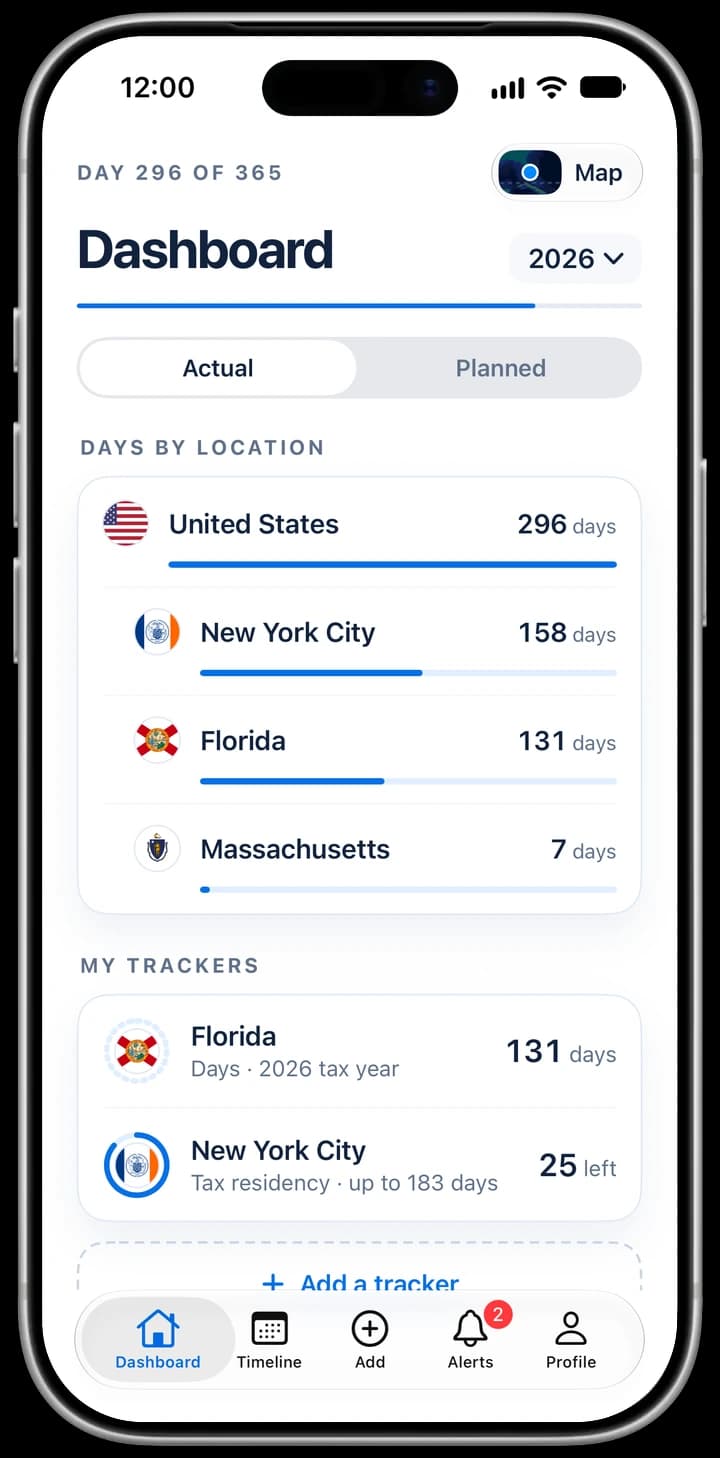
- Yes. iReside counts your days in every state from your phone's location, with nothing to log by hand, counts New York City separately from New York State, and alerts you before you reach a state's limit.