RSU Tax When You Move States or Countries
Quinn Moran · August 25, 2026
When you move states or countries before your RSUs or options vest, the income is generally sourced to where you worked while you earned it, not where you live when it pays out. New York, for example, allocates option income using the New York workday fraction across the grant-to-vest period. Move mid-vest and your former state or country keeps a claim on the matching share, often years after you left.
On this page
Most people carry a simple mental model of how moving works: you leave, you file a part-year return, and from the following year your income belongs to the new place.
For salary, that model is roughly right. For equity, it is wrong in a way that surfaces two or three years later, usually in the form of a letter about a return you did not know you had to file.
Equity compensation is not taxed where you live when it pays out. It is sourced to where you were working while you earned it. For a four-year vest, that means a slice of the grant belongs to every jurisdiction you worked in across those four years, in proportion to the days you worked there.
So the operative question is an unglamorous one: can you produce a defensible record of where you worked, by day, going back to the grant date? Automatic location tracking is the practical answer for most people: iReside records the country, state, or province you were in each day, so the history exists rather than being rebuilt from calendars and expense reports years later.
An executive who has been through two international assignments and a relocation is carrying claims from every one of them, and the sourcing rules have a specific shape. Understanding it changes what you need to keep, and for how long.
How are RSUs taxed when you move states? Services performed, not residence
The federal starting point is that compensation for personal services is sourced to where the services were performed. For compensation attributable to a period longer than one year, Treas. Reg. §1.861-4(b)(2)(ii) allocates on a time basis: the fraction of total compensation sourced to a place is the number of days you performed services there over the total days of service the payment covers.
The OECD Model reaches the same conclusion for treaty purposes. Employment income under Article 15 belongs to the state where the employment is exercised, and where an equity award spans several countries, the benefit is attributed across the period in which the employee performed the services that earned the right to it.
So the model to hold is not "where do I live" but "where was I working while this grant was being earned, and for how many days."
Which period counts: grant to vest, or grant to exercise?
Once you accept the time basis, the whole outcome turns on which period counts. Grant to vest? Grant to exercise? Vest to exercise?
For US federal purposes, the accountable period for a stock option is generally the span between grant and the date all employment-related conditions have been satisfied, which is vesting. Post-vest appreciation is not compensation for services; it is investment return.
New York's regulation is worth reading closely, because it is the most explicit and it is the one most mobile executives will actually meet. Under 20 NYCRR §132.24, income from stock options, stock appreciation rights and restricted stock is allocated by the New York workday fraction over the allocation period. For options and stock appreciation rights that period runs from the date of grant to the date all service-related conditions for exercise are satisfied; for restricted stock without a section 83(b) election it runs from receipt to the date the stock substantially vests. The numerator is days worked in New York for the grantor during that period; the denominator is days worked everywhere for the grantor during the same period.
The regulation's own worked example is clarifying. A nonresident employee is granted options that become exercisable after five years of service. Over that five-year allocation period the employee has a workday fraction of 720/1200. When the options are exercised the following year, $70,000 of compensation is recognised, and 720/1200 × $70,000 = $42,000 of it is New York source income, even though the exercise falls after the allocation period has closed.
RSU tax after moving out of New York: a worked example
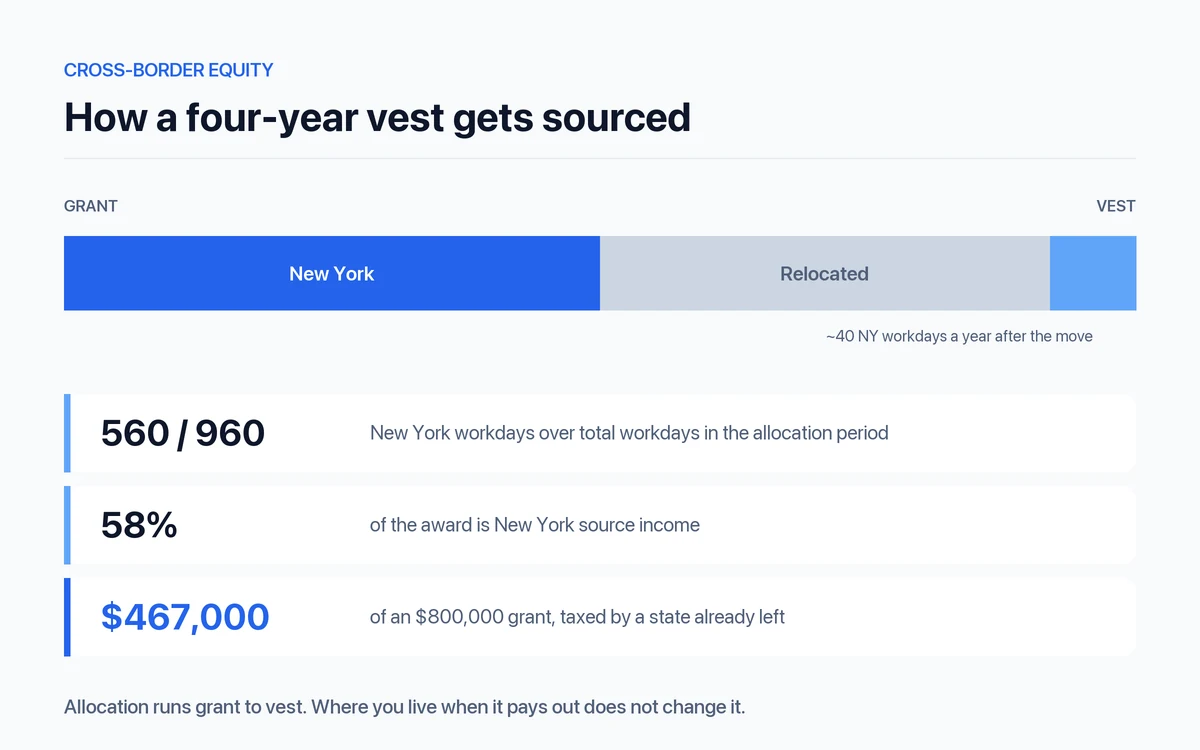
Take an executive granted $800,000 of RSUs vesting over four years, who spends the first two years working in New York and then relocates to a state with no income tax.
If the workdays split evenly, say 480 New York workdays out of 960 total across the vesting period, then 50% of the award is New York source. That is $400,000 of New York-source income, taxable in New York, recognised in years when the executive is a nonresident who may not have set foot in the state.
Now change one fact. Suppose that in years three and four the executive returned to New York for client work about 40 workdays a year, 80 across the two years. That pushes the fraction to 560/960, about 58%, or $467,000. The extra $67,000 of New York-source income came from travel nobody logged, because nobody was thinking of a client visit as an input to a four-year-old grant.
That second scenario is the ordinary case for a mobile executive, and it is the one that has no evidence behind it.
Why this specifically catches the globally mobile
Four features of this population make the exposure worse than for a typical relocating employee.
The trailing liability outlasts the move. A grant made before you left keeps producing sourced income in the old jurisdiction for years afterwards. People close out a move mentally when they file the part-year return; the equity does not close out until the last tranche vests.
Payroll will not fix it for you. Employer withholding is driven by the work location and residency on file, not by a reconstruction of where you actually worked across a multi-year vest. Payroll often has no visibility at all into business travel days. Under-withholding does not reduce what is owed, and over-withholding means reclaiming through returns you have to file anyway. The reconciliation is yours.
Jurisdictions disagree about the window, and that produces genuine double taxation. If one country allocates grant-to-vest and another allocates grant-to-exercise, the same slice of income can be claimed twice with no single treaty answer. Foreign tax credits and state credits relieve much of this, but relief is capped, timing-mismatched, and dependent on your being able to substantiate the allocation in both places. The credit is only as good as the day count behind it.
The counting unit is workdays, not presence days. This is the nuance that trips up people who have started tracking. The federal rule counts days of performance of services; New York counts days worked. A weekend in the state is not a workday there. A location log tells you where you were; it does not by itself tell you whether that Tuesday was a working day or annual leave. You need both, and the presence record is the half that is impossible to reconstruct later: whether a given day was worked is something you can usually establish from calendars and email, but where you physically were is not.
The convenience rule makes it stranger
In a handful of states, the physical day count and the sourced workday count deliberately come apart.
Under a convenience of the employer rule, days you worked remotely for your own convenience rather than your employer's necessity are treated as days worked in the employer's state. New York is the most aggressive user of the rule. The practical effect is that a day spent working from your home in another state can still be a New York workday for allocation purposes, including inside the vesting-period fraction above.
We covered the mechanics in the convenience of the employer rule explained, and the interaction with equity is the part most people miss: the rule does not just affect this year's salary, it reaches into the workday fraction that sources a grant made years ago.
What you actually need to keep
For each grant, the record has to answer three questions across the whole allocation period:
Where were you, each day? This is the part that cannot be reconstructed credibly after the fact. Boarding passes cover flights, not driving; card statements cover spending, not location; and passport stamps are disappearing as the EU's Entry/Exit System replaces them across 29 countries. A contemporaneous daily record is now the most practical evidence most people can produce, which is the argument we made at length in proving where you were in 2026.
Was it a workday? Calendars, timesheets, and email traffic usually establish this well enough, and they survive in corporate systems.
What was the grant's allocation period? Grant date, vesting schedule, and the plan terms. Keep the grant documents with the day record, because in five years the two will need to be read together and the equity administration platform may not still be the same one.
Then keep all of it for as long as the longest relevant assessment window, which is longer than you think: some states have effectively unlimited windows where no return was filed.
The bottom line
Equity compensation is the last part of a move to actually complete. The house sells, the driver's licence changes, the part-year return gets filed, and a claim from the old jurisdiction keeps accruing quietly inside a vesting schedule for another three years.
The rule itself is not unreasonable: you earned the award over a period, and the places you worked during that period get a proportionate share. What makes it painful is that the proportion is built from a day count nobody was keeping at the time, and by the time the number matters the days are years gone.
The cheapest possible fix is to have the days already. If you want to sanity-check a specific state's residency thresholds alongside the sourcing question, our state-by-state lookup and 183-day calculator run in the browser, and which state is taxing your income covers the wider multi-state picture. The New York residency guide covers the state most mobile executives meet first.
Sources
- 26 CFR § 1.861-4, Compensation for labor or personal services: the time-basis allocation for multi-year compensation.
- Sourcing of Multi-Year Compensation Arrangements, IRS practice unit: the grant-to-vest accountable period for stock options.
- Sourcing of Salary and Compensation, IRS LB&I process unit
- 20 NYCRR § 132.24, Stock options, stock appreciation rights and restricted stock: the New York workday fraction and the 720/1200 worked example.
- The Nuts and Bolts of Nonresident Wage Allocation in New York, Hodgson Russ
- OECD Model Tax Convention, 2017 condensed version: Article 15 and the attribution of employment income.