7 States Can Tax You Even If You Never Set Foot There: The Convenience of the Employer Rule Explained for 2026
Quinn Moran · March 31, 2026
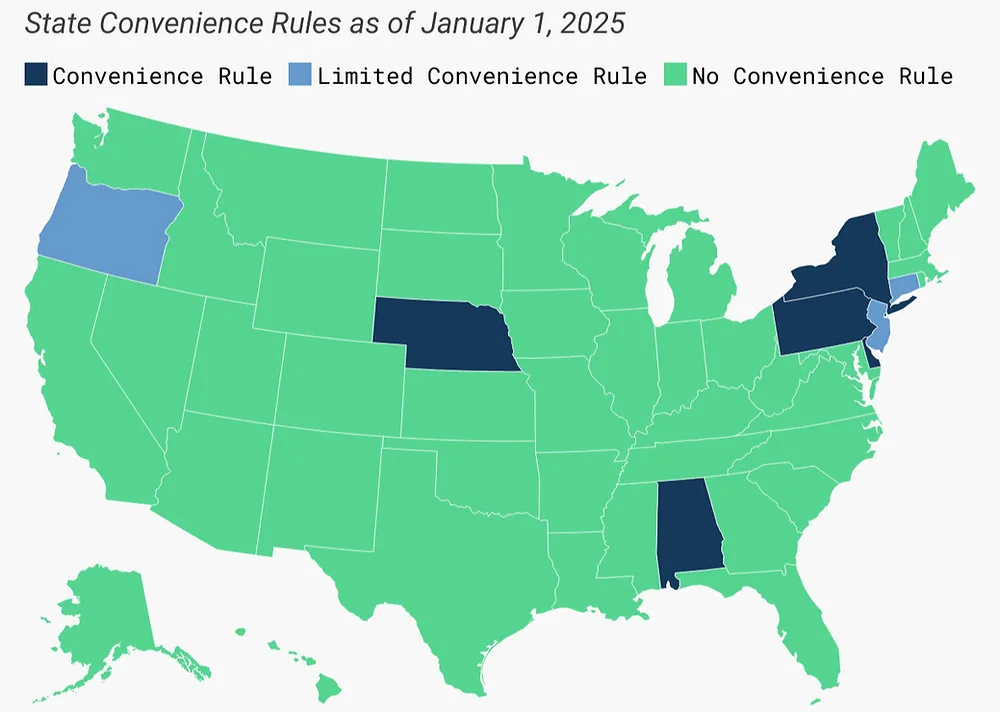
States With Convenience Rules
Imagine this scenario: you live in Florida, a state with no income tax. You work remotely for a company headquartered in New York. You have never visited the New York office. You have never set foot in New York State during the entire tax year. And yet, when tax season arrives, you discover that New York wants to tax your entire salary as if you had been working in Manhattan every single day.
This is not a glitch in the tax code. It is a deliberate policy known as the convenience-of-the-employer rule, and it is one of the most controversial and misunderstood provisions in state tax law. In 2026, with tens of millions of Americans working remotely, this rule affects more taxpayers than ever before, and most of them have no idea it exists.
If you work remotely for a company based in another state, if you are a digital nomad earning income from multiple clients, or if you are a business owner with employees scattered across the country, this article will explain exactly how the convenience of the employer rule works, which states enforce it, and how you can protect yourself.
What Is the Convenience of the Employer Rule?
The convenience of the employer rule is a tax doctrine that allows certain states to tax the income of nonresident employees who work remotely for employers located within that state. The rule says that if you work from home (or from another state) for your own convenience rather than because your employer requires you to work remotely, the state where your employer is located can tax your income as if you were physically working there.
In plain English: if your employer has an office in New York and you choose to work from your home in Florida, New York considers your remote work arrangement to be for your personal convenience. Because it is for your convenience and not a business necessity of your employer, New York claims the right to tax your income.
The only way to escape this rule is to prove that your remote work location is a necessity for your employer, meaning the employer requires you to work from that location for legitimate business reasons, not just because you prefer it. The bar for proving employer necessity is extremely high, and in practice, very few taxpayers successfully make this argument.
Which States Enforce the Convenience Rule in 2026?
As of 2026, the following states enforce some version of the convenience of the employer rule:
New York: The Most Aggressive Enforcer
New York is the state most closely associated with the convenience rule and enforces it more aggressively than any other. If you work remotely for a New York-based employer, New York will allocate your income to New York unless your employer can demonstrate that your remote work location serves a bona fide business purpose. New York's Department of Taxation has made clear that working from home during and after the pandemic does not qualify as employer necessity: it remains employee convenience.
According to tax practitioners at Hodgson Russ LLP and other firms specializing in New York tax, the state's position has remained firm despite widespread remote work adoption. New York views the convenience rule as essential to protecting its tax base from erosion as workers relocate to lower-tax states while keeping their New York jobs.
Pennsylvania
Pennsylvania applies a version of the convenience rule that allocates income to Pennsylvania when a nonresident employee works remotely for a Pennsylvania employer. The rule is less publicized than New York's but can have significant tax consequences for remote workers, particularly those living in states without reciprocal tax agreements with Pennsylvania.
Delaware
Delaware enforces a convenience rule that taxes nonresident employees of Delaware-based companies on income earned while working remotely. Given that Delaware is home to a disproportionate number of corporate headquarters due to its business-friendly incorporation laws, this rule can affect remote workers who may not even realize their employer is technically a Delaware company.
Connecticut
Connecticut's convenience rule is notable because the state also has a reciprocal credit arrangement with New York. This creates complex interactions for workers in the tri-state area. If you live in Connecticut and work remotely for a New York employer, both states may claim taxing authority over your income. While credits are available to prevent full double taxation, the interaction of these rules can result in a higher effective tax rate than working in either state alone.
Nebraska
Nebraska enacted its convenience rule more recently and applies it to nonresident employees who work remotely for Nebraska-based employers. While Nebraska's income tax rates are lower than New York's, the rule can still create unexpected tax obligations for remote workers who assumed their income would only be taxed in their state of residence.
Arkansas
Arkansas updated its convenience of the employer doctrine in recent years and applies it to certain remote work arrangements involving Arkansas-based employers. The state's evolving approach to this issue means that remote workers should monitor legislative changes closely.
Massachusetts
Massachusetts implemented an emergency pandemic-era rule that taxed remote workers who had previously commuted to Massachusetts, and elements of this approach have persisted. While Massachusetts has modified its position since the height of the pandemic, the state continues to assert taxing authority over certain remote work arrangements involving Massachusetts employers.
How the Convenience Rule Creates Double Taxation
The most insidious aspect of the convenience rule is its potential to create double taxation. Here is how it works in practice.
You live in Georgia and work remotely for a New York employer. Georgia taxes you as a resident on all your income because you live there. New York also taxes your income under the convenience rule because your employer is based there and your remote work is deemed to be for your convenience.
In theory, Georgia should give you a credit for taxes paid to New York, which would eliminate the double taxation. In practice, however, Georgia only gives you a credit for taxes paid to New York on income actually earned in New York. Because you never physically worked in New York, Georgia may argue that you did not actually earn any income in New York, meaning no credit.
The result? You pay full state income tax to both Georgia and New York on the same income. This is not a theoretical risk. According to tax practitioners at firms like Uncle Kam Tax Strategy and Unison Globus, this exact scenario plays out for thousands of remote workers every year.
The Employer Necessity Exception: Why It Rarely Works
The only escape from the convenience rule is to prove that your remote work location is a necessity for your employer, not merely a convenience for you. In practice, this exception is extremely narrow.
To qualify for the employer necessity exception in New York, for example, you generally need to demonstrate that your employer does not have suitable office space available for you in New York, that your work requires you to be in another location (such as a client site or a specialized facility), or that there is a specific, documented business reason why you cannot perform your job from the employer's New York office.
Simply preferring to work from home, having a shorter commute, or even having been told by your employer that you can work remotely does not qualify. The fact that your employer allows remote work is not the same as requiring it. Tax courts have consistently held that employer permission is not employer necessity.
This distinction matters enormously. If your employer has a desk available for you in their New York office and you choose not to use it, New York considers your remote work to be for your convenience. Period.
How the Convenience Rule Affects Different Types of Workers
Full-Time Remote Employees
If you are a full-time remote employee working for a company in a convenience-rule state, your entire salary may be subject to tax in that state. This is true even if you have never visited the state, even if your employer hired you as a remote worker, and even if there is no expectation that you will ever work from the employer's office.
Hybrid Workers
If you split your time between working in your employer's office and working from home in another state, the convenience rule affects how your income is allocated. Days worked in the employer's state are taxed there regardless. Days worked from home may also be taxed there under the convenience rule. Only days where you work from a location that serves a bona fide employer necessity may be excluded.
Freelancers and Independent Contractors
The convenience rule primarily applies to employees, not independent contractors. However, freelancers face their own multi-state tax challenges. If you physically perform work in a state, that state generally has the right to tax the income earned there, regardless of the convenience rule. Freelancers who travel between states need to track which state they were in when they performed each piece of work, a task that iReside automates with GPS-based day counting.
Business Owners with Remote Teams
If you run a business based in a convenience-rule state and have employees working remotely from other states, you need to understand your withholding obligations. Some convenience-rule states require employers to withhold state income tax from remote employees' paychecks, even if those employees live and work in other states. Failure to withhold correctly can create liability for the employer.
What About Reciprocal Agreements?
Some states have reciprocal tax agreements that allow residents of one state to be exempt from income tax in the other. For example, New Jersey and Pennsylvania have a reciprocal agreement. However, reciprocal agreements generally do not override the convenience of the employer rule.
If you live in a state that has a reciprocal agreement with a convenience-rule state, the interaction between the two provisions can be complex. Tax practitioners recommend working with a CPA who specializes in multi-state taxation to understand exactly how these rules apply to your specific situation.
How to Protect Yourself From the Convenience Rule
Document Everything
The single most important thing you can do is document where you work every day. If you are ever audited, you will need to prove which days you worked in which state. A GPS-based tracking app like iReside creates this documentation automatically, recording your location every day without requiring manual input.
Understand Your Employer's Policy
Ask your employer whether they have a formal policy requiring remote work or merely permitting it. If your employer can document that your remote work location is a business necessity, you may qualify for the employer necessity exception. Get this documentation in writing.
Work With a Multi-State Tax CPA
The convenience rule creates tax situations that are too complex for standard tax software. You need a CPA who understands multi-state taxation, the convenience rule, and the specific rules of every state involved. iReside's CPA portal allows your tax professional to access your GPS-verified location data directly, making it easier for them to accurately allocate your income across states.
Track Your Days With GPS
This cannot be overstated: automated GPS tracking is the foundation of your defense. Fighting the convenience rule, proving employer necessity, and allocating income accurately all require a day-by-day record of where you physically worked. iReside provides this automatically, with real-time threshold monitoring, compliance alerts, and export-ready reports.
Consider the Tax Impact Before Accepting a Remote Position
If you are considering a remote job with a company based in New York, Connecticut, Pennsylvania, or another convenience-rule state, factor the potential state tax liability into your compensation analysis. A job paying $200,000 from a New York employer may net significantly less than the same salary from a Texas-based employer once New York's convenience rule is applied.
The Push for Federal Reform: The Mobile Workforce Act
Congress has repeatedly introduced the Mobile Workforce State Income Tax Simplification Act, which would establish a uniform 30-day threshold across all states, effectively overriding the convenience rule. Under this proposed legislation, a state could not tax a nonresident's income unless the nonresident worked in the state for more than 30 days during the year.
As of 2026, the bill has been reintroduced as S.1443 in the 119th Congress. While it has bipartisan support, it has not yet been enacted into law. Until it passes, the convenience rule remains in full effect in the states that enforce it.
If the Mobile Workforce Act does eventually pass, precise day counting will become even more critical, as the 30-day threshold will need to be tracked carefully for every state. Tools like iReside that automatically count days per state will be essential for compliance under any new federal framework.
Frequently Asked Questions
Can New York really tax me if I never set foot in the state?
Yes. Under the convenience of the employer rule, New York can tax your income if you work remotely for a New York employer and your remote work is deemed to be for your convenience rather than your employer's necessity. Physical presence in New York is not required.
What if my employer told me I could work from home?
Permission to work remotely is not the same as a requirement to work remotely. New York and other convenience-rule states distinguish between employer permission (which is considered employee convenience) and employer necessity (which may exempt you). Your employer must be able to document a specific business reason for your remote work location.
How do I prove where I worked each day?
The most reliable method is automated GPS-based tracking with an app like iReside. The app records your location every day in real time, creating contemporaneous evidence that is far more credible in an audit than a manually maintained calendar or spreadsheet.
Can I get a tax credit to offset double taxation?
It depends on your state of residence. Some states offer credits for taxes paid to other states, but these credits may not fully offset the liability created by the convenience rule. The interaction between the convenience rule and state tax credits is complex and varies by state.
Which state should I list as my work state on my W-4?
Consult with a multi-state tax CPA. Your withholding should reflect the actual tax obligations in each state where you may owe taxes. Incorrect withholding can result in underpayment penalties.
Take Control of Your Multi-State Tax Exposure
The convenience of the employer rule is one of the most significant and least understood tax provisions affecting remote workers in 2026. If you work for a company based in New York, Pennsylvania, Connecticut, Delaware, Nebraska, Arkansas, or Massachusetts, you may owe state income tax to that state even if you never visit it.
The best defense is documentation. Know the rules, understand which states claim your income, and track where you work every single day. iReside does this work for you: automatic GPS tracking, real-time day counting across all 50 states, compliance threshold alerts, AI-powered scenario analysis, and professional CPA reporting.
Do not wait until you receive an audit notice or a surprise tax bill. Download iReside today and take control of your multi-state tax exposure. Your location data is your strongest evidence. Make sure you are collecting it before you need it.