UHNW Tax Residency in 2026: Four Day Clocks
Quinn Moran · August 25, 2026
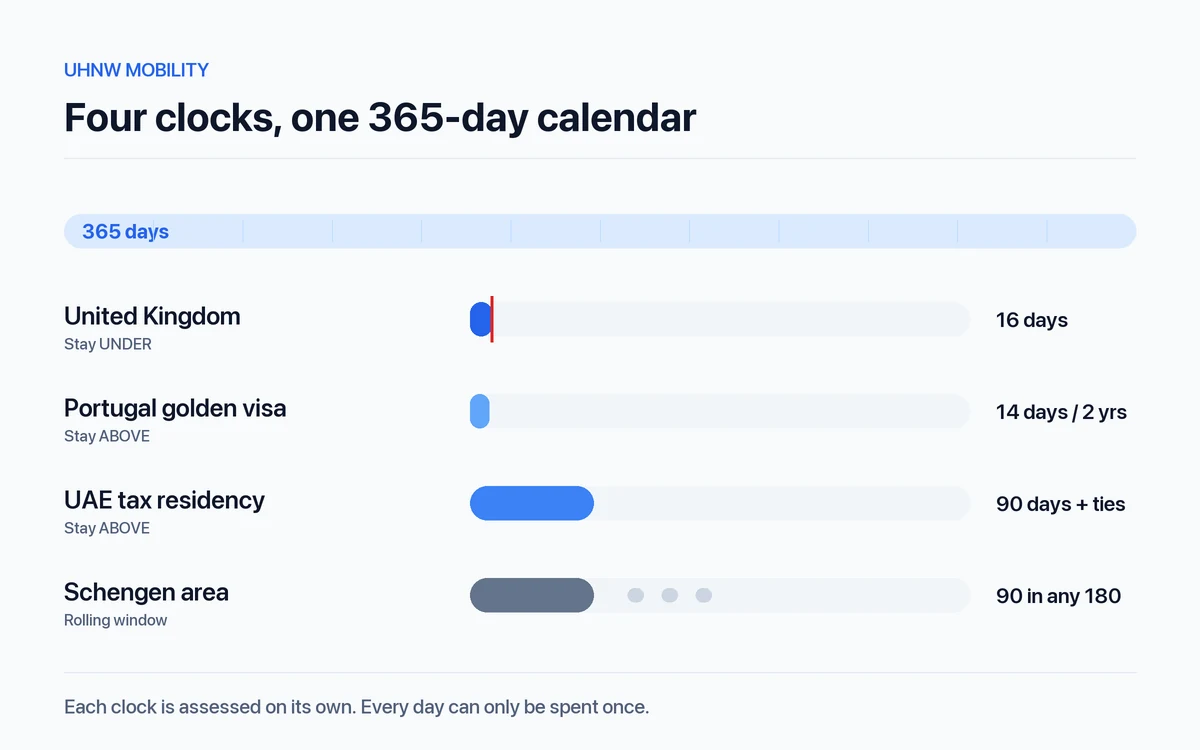
A UHNW mobility plan usually runs four or more jurisdictions at once, and each one applies an independent day test to the same 365 days: ceilings you must stay under, residency minimums you must stay above, rolling windows like Schengen 90/180, and multi-year clocks for settlement or citizenship. They compete for the same calendar, and the binding constraint is almost never the money.
On this page
The planning conversation for a mobile UHNW family tends to happen in structures. Which holding company, which trust, which jurisdiction, which treaty, which programme.
The failure, when it comes, almost never happens in structures. It happens in the calendar.
A structure is durable: it holds its shape until somebody deliberately changes it. A residency position is not durable at all. It is recalculated every single year from a fresh set of 365 days, and the family has to hit every target in that year simultaneously, in a world where the targets are set by four or five governments that have never coordinated with one another.
This is why the tooling question comes up early for people at this level. iReside records which country, state, or province you are in each day from your phone, which is a mundane thing to want until you realise the alternative is reconstructing four competing counts from boarding passes eighteen months after the fact. What follows is less about the tool than about the shape of the problem it addresses, because the shape is not obvious even to people living inside it.
Which day tests apply to a UHNW family? Four kinds of clock
The reason UHNW mobility is structurally harder than it looks is that the constraints are not all the same kind of constraint. There are four, and they point in different directions.
Ceilings: days you must stay under. These are the tax residency triggers. Spend too many days and a country taxes your worldwide income. Most US states use 183 days alongside a permanent place of abode. The UK's Statutory Residence Test applies a tie table where the ceiling can fall as low as 16 days for someone recently resident. Spain's is 183. These are the numbers people usually know.
Floors: days you must stay above. These come from immigration, and they run the opposite way. A residency-by-investment permit requires minimum presence to stay alive. Portugal's golden visa asks for 7 days in the first year and 14 in each subsequent two-year period. The UAE's 90-day tax residency test requires 90 days plus ties within any 12 consecutive months if you want the certificate. UK settlement works as an inverted floor: no more than 180 days of absence in any rolling 12 months during the qualifying period.
Rolling windows. These do not reset on 1 January, which is what makes them dangerous. Schengen's 90/180 rule is assessed on any 180-day period looking backwards, so a compliant calendar year can still contain a breach. The UK settlement absence rule works the same way, and our guide walks a worked example where two separate trips, each fine on its own and fine in each calendar year, break continuous residence when the rolling window catches both.
Multi-year cumulative clocks. Naturalisation and settlement applications reach back years. US naturalization requires five years of continuous residence plus 30 months of physical presence. The Substantial Presence Test reaches back three years on a weighted formula: all of this year's days, a third of last year's, a sixth of the year before. A decision made in 2024 is still doing arithmetic in 2026.
A family running a golden visa, a settlement application, a treaty position, and a tax-residency ceiling is running all four kinds at once. And every day of the year is an input to several of them at the same time. A day in Lisbon is a credit against one clock and a debit against another.
Where they collide
Consider a fairly ordinary set of facts: a principal with a Portuguese golden visa held for the optionality, a UAE base, a house in London used a few weeks a year, and children at school in Switzerland.
The Portuguese permit needs only 7 or 14 days. That is easy. But the UAE certificate wants 90 days plus ties in a 12-month window, and those 90 days are not available at the same time as a meaningful presence in London or Switzerland. The London house is a UK tie, which lowers the SRT ceiling; the children's location is another. If the principal was UK resident in any of the previous three tax years, the automatic overseas test that matters is fewer than 16 days, which is roughly a fortnight for the whole year and is spent by two board meetings and a school event.
Meanwhile the Portuguese residence permit does not create free movement. Days in Portugal sit under Portuguese national rules and do not draw on the Schengen short-stay allowance, but time in France, Italy or Germany still does. The Swiss school runs are drawing on a rolling window that nobody in the structure is tracking.
Nothing here is aggressive. Every individual element is standard planning. The position fails because 365 days will not stretch to cover 90 in the UAE, a floor in Portugal, a ceiling of 16 in the UK, and a rolling Schengen allowance that the school calendar quietly consumes.
This is the characteristic UHNW failure. Not a bad structure. An over-subscribed calendar.
Can you be tax resident in two countries? Treaty tie-breakers are a backstop, not a plan
The usual reassurance is that a treaty will sort it out. It is worth being precise about how much work a treaty actually does.
Where two countries both conclude you are resident under domestic law and a treaty exists between them, the tie-breaker in Article 4 of the OECD Model runs as a cascade: permanent home available to you, then centre of vital interests, then habitual abode, then nationality, then agreement between the two administrations.
Three things about this matter for planning.
It only operates where a treaty exists between that specific pair of countries, and it only covers what the treaty covers. It resolves residence for treaty purposes, not every domestic consequence.
Two rungs of the cascade are themselves questions of fact you must evidence. Habitual abode is substantially a day-count comparison. Centre of vital interests is a personal and economic connections analysis that looks a great deal like a US state domicile audit.
And the corporate analogue got weaker, which is a signal about direction of travel. The 2017 update to the OECD Model removed the automatic place-of-effective-management tie-breaker for dual-resident companies and replaced it with a mutual agreement procedure: the two tax administrations negotiate, and you wait. Certainty moved from the rule book to the negotiating table.
A treaty is a backstop for a position that has already gone wrong. It is not a substitute for the count.
The number at the end: the 2026 US exit tax thresholds
For US citizens and long-term green card holders, the mobility plan has a terminal event, and it is priced in advance.
Under section 877A you are a covered expatriate if any one of three tests is met:
- Your net worth is $2 million or more on the expatriation date.
- Your average annual net income tax for the five years ending before expatriation exceeds $211,000 for 2026, indexed annually.
- You cannot certify five years of US tax compliance.
If you are covered, the regime deems a sale of your worldwide assets at fair market value the day before expatriation. For 2026 the resulting gain is reduced, but not below zero, by an exclusion of $910,000, set by Revenue Procedure 2025-32. Everything above it is taxable.
Two observations that matter more than the numbers.
The net worth test alone catches essentially every UHNW individual, which means covered status is not something to plan around. It is a given, and the planning is about what the deemed sale lands on and when.
The compliance certification test is the one that turns a day count into a hard problem. Certifying five years of compliance means the years behind you have to have been filed correctly, which means the residency positions you took in those years have to hold up. A weak day count from three years ago is not a historical curiosity at that point. It is the thing standing between you and the certification.
The evidence, which is now harder to produce
All of this rests on being able to show where you were.
The traditional record was the passport stamp, and it is going away. The EU's Entry/Exit System has replaced stamping with a biometric database across 29 countries, so someone moving regularly through Europe will accumulate very few stamps from here on. The data exists in government systems, it is slow to obtain, and it does not cover the borders EES does not operate. We covered the practical consequences in proving where you were now that passport stamps are disappearing.
What replaces it is a contemporaneous record: something written down day by day at the time, rather than reconstructed once an enquiry has opened. Revenue authorities accept both. They do not weigh them equally, and an auditor can tell the difference between a log and a reconstruction in about ninety seconds.
There is also a compounding problem specific to this population. The retention period is set by the longest window in any jurisdiction you touch, not the shortest. Some US states have effectively unlimited assessment windows where no return was filed. A naturalisation application can reach back a decade. Records that felt safe to discard usually were not.
What competent looks like
The families who run this well are not doing anything clever. They are doing four unglamorous things.
They count continuously, not annually. The entire value of the number is in having it early enough to change the answer. At 150 days you have options; at 189 you have a filing position.
They count every clock, not the famous one. The 183-day ceiling is the number everyone knows and rarely the one that breaks. The rolling window and the immigration floor are the ones that go unwatched.
They capture automatically rather than self-report. A self-maintained travel diary is late and incomplete by the time it matters, because nobody writes down a day trip. This is the specific job iReside does: it records the country, state, or province for each day from the phone's own location and keeps the history, so the record exists before anybody needs it.
They keep the whole family in one view. A UK-resident spouse is itself a tie under the UK's SRT, and a spouse's location is a weighted factor in most US state domicile analyses. Children's location is a connecting factor. Counting only the principal counts a fraction of the exposure, which is why we wrote separately about the four day counts a family office carries.
The bottom line
The instinct at this level of wealth is that complexity is solved with more structure. For residency, the opposite is closer to true. Every additional jurisdiction adds another independent test drawing on the same fixed 365 days, and the tests do not negotiate with each other.
The position that fails is rarely the aggressive one. It is the perfectly defensible one, held by someone who could not prove the days, in a year when four clocks wanted more calendar than existed.
To check any single position, our 183-day calculator, UK Statutory Residence Test calculator, Schengen 90/180 calculator and Substantial Presence Test calculator run entirely in the browser. For the wider framework, international tax residency and why day counts matter is the place to start.
Sources
- Expatriation tax, IRS: the three covered expatriate tests and the year-by-year average annual net income tax thresholds.
- Revenue Procedure 2025-32, 2026 inflation adjustments, sections 3.37 and 3.38, IRS: the 2026 section 877A exclusion of $910,000 and the $211,000 average annual net income tax threshold.
- Substantial presence test, IRS: the weighted three-year formula.
- 2017 Update to the OECD Model Tax Convention: the replacement of the Article 4(3) tie-breaker with a mutual agreement procedure.
- OECD Model Tax Convention, 2017 condensed version: the Article 4 residence tie-breaker cascade.
- Check if you can claim the 4-year foreign income and gains regime, GOV.UK