Canada PR Residency Obligation Calculator
A permanent resident must be physically present in Canada for at least 730 days in every rolling five-year period. Enter your time outside Canada and see where you stand.
Runs entirely in your browser. 100% private.
- Rolling five-year window, assessed at any date
- 730 days required, 1095 days of absence affordable
- Overlapping trips counted once
- Shows absence still available before you breach
Time spent outside the country
Meets the requirement with 1825 days
1825 days present of the 730 required, in the window 2021-10-09 to 2026-10-07.
These counts have to hold for years, and reconstructing them later rarely convinces anyone. iReside keeps the record as it happens.
Five years is a long time to remember accurately
The obligation is assessed on any date an officer chooses, not on an anniversary. iReside keeps the running count so a renewal is never a surprise.
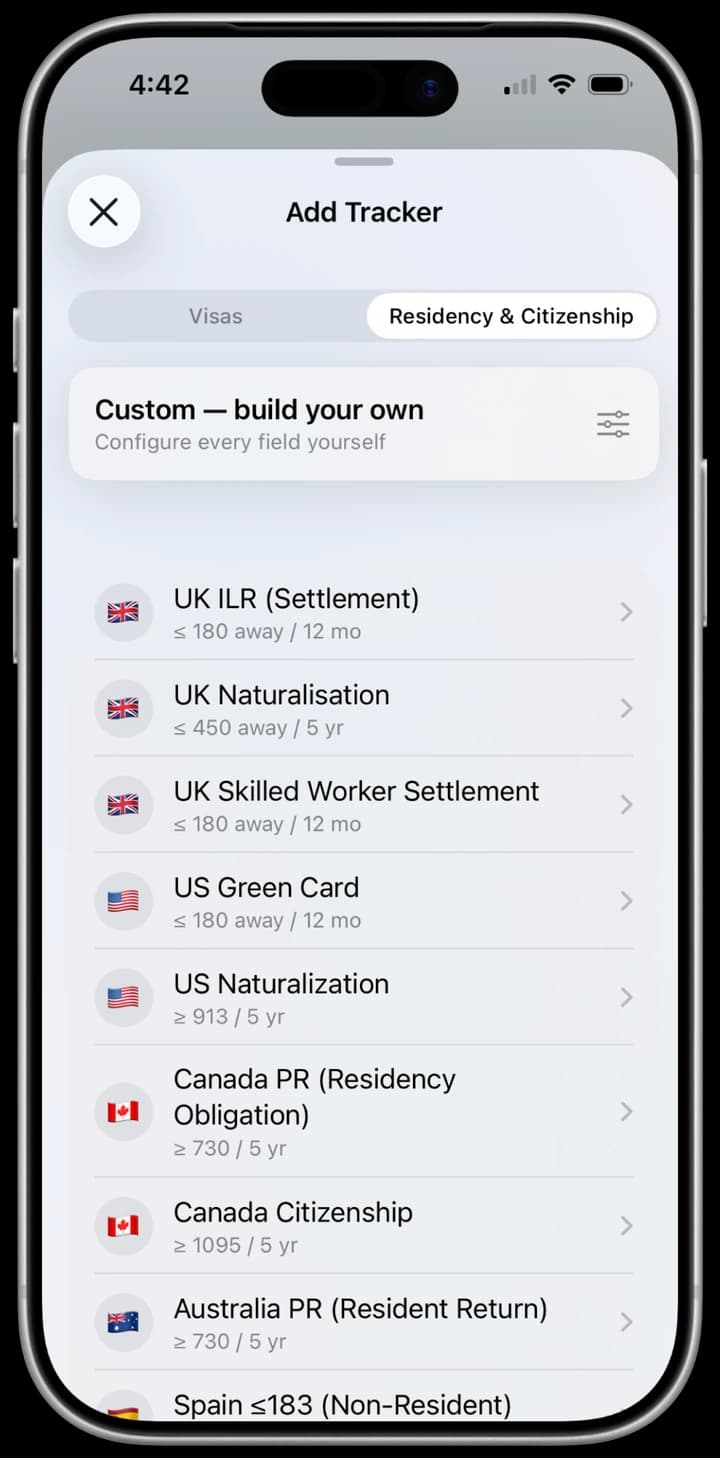
In the iReside app
Canada PR's 730 days, as a tracker
Pick the Canada PR (Residency Obligation) preset and iReside keeps the five-year count from your iPhone's location. The same list has presets for US, UK and Australian residency and citizenship rules.
Common questions
- What is the PR residency obligation?
- Under IRPA section 28, a permanent resident must be physically present in Canada for at least 730 days within every rolling five-year period. It is not 730 days once; the test can be applied at any moment.
- How much time can I spend outside Canada?
- 1095 days across five years, since 1825 minus 730 is 1095. That is three years of absence, which sounds generous until it accumulates across several years of frequent travel.
- When is the obligation assessed?
- At any time an officer examines your status, most commonly on PR card renewal or on re-entry to Canada. Because the window rolls, someone can drift out of compliance without any single trip looking excessive.
- Do days abroad with a Canadian spouse count?
- They can. Time accompanying a Canadian citizen spouse or common-law partner abroad, and certain employment with a Canadian business, may count toward the 730 even though you were not in Canada. Those provisions are fact-specific and this calculator does not model them, so it gives the pure physical-presence position.
- What happens if I fall short?
- You can be reported and lose permanent resident status, though humanitarian and compassionate considerations may be taken into account, particularly the best interests of any child affected. Falling short is not automatically fatal, but it is a serious position to be in.
- Does this apply to citizens?
- No. Once you become a Canadian citizen there is no residency obligation. The obligation applies only while you hold permanent resident status.
Related tools
Track your days automatically
Stop counting manually. iReside uses GPS to log your state every day in the background. Get alerts before you hit thresholds. Generate audit-ready reports with one click.
$34.99/year after free trial. Cancel anytime.
This calculator is for informational purposes only and does not constitute tax, legal, or financial advice. Tax residency rules are complex and vary by jurisdiction. Consult a qualified tax professional for advice specific to your situation.
Generated by iReside, ireside.ai/tools
Track your state residency days automatically with GPS. Download iReside: apps.apple.com/app/ireside/id6752501722
For informational purposes only, not tax advice.