Leaving Massachusetts in 2026? How the DOR Tracks Former Residents, the 9% Millionaire's Tax, and What It Actually Takes to Leave
Quinn Moran · May 9, 2026
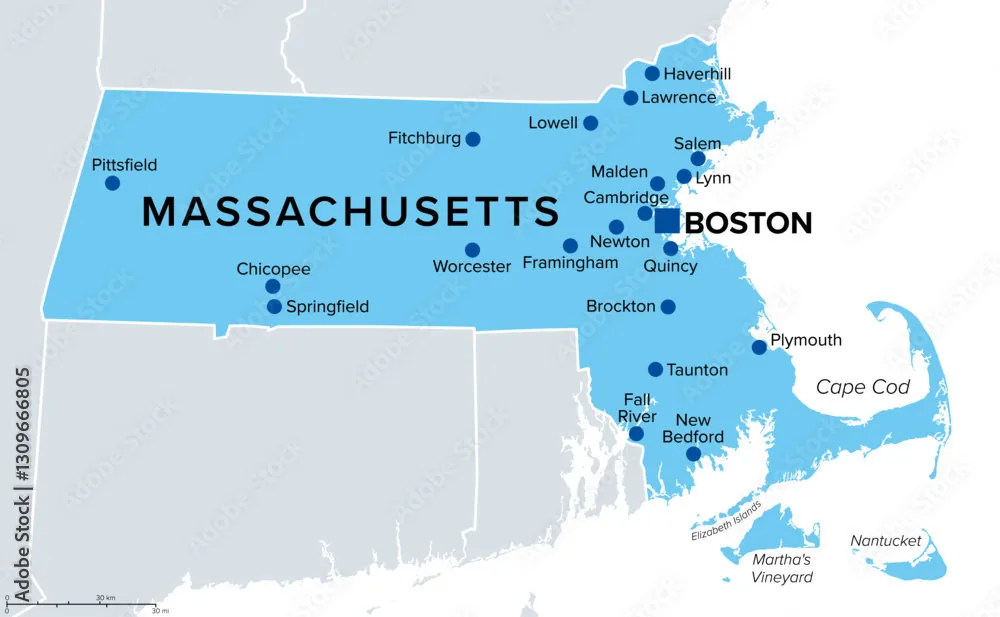
Massachusetts has quietly become one of the most expensive states in America to be wealthy in. Between the 5% flat income tax, the new 4% surtax on income above roughly $1 million, an estate tax with a $2 million cliff and no portability between spouses, and a Department of Revenue that treats domicile claims with the same skepticism as the New York Department of Taxation and Finance, the financial case for leaving has never been stronger. And the data shows people are doing exactly that.
According to IRS migration data released in 2026, Massachusetts lost more than 30,000 residents on a net basis between 2022 and 2023, and those departures took roughly $4.2 billion in adjusted gross income with them. The biggest income losses came from households earning above $200,000. Florida was the single largest destination for departing Massachusetts residents, followed by New Hampshire and Texas.
If you are considering joining that exodus, this is the guide that will tell you what actually matters. We will cover how Massachusetts defines a tax resident, the obscure 100-day rule that triggers DOR scrutiny, how the Fair Share Amendment changed the math for high earners, how the estate tax can still reach you years after you leave, and the precise documentation you need to win a residency audit. This is not a list of generic moving tips. It is what the Massachusetts DOR actually looks at when they decide whether to come after you.
The Cost of Staying: What Massachusetts Actually Charges in 2026
The headline number is the 5% flat income tax, which by itself is competitive. The problem is everything stacked on top of it.
For income above $1,053,750 in 2026 (the inflation-adjusted threshold for the Fair Share Amendment), Massachusetts adds a 4% surtax. That puts the top marginal rate at 9% on every dollar above the threshold. This applies to wages, business income, capital gains, and one-time liquidity events like the sale of a company or a large stock vesting. A founder who sells her company for $20 million pays roughly $1.78 million in state tax. A retired executive realizing $5 million in long-term capital gains on appreciated stock pays $445,000. These are not edge cases. They are why people are calling moving companies.
On top of that, Massachusetts imposes a separate estate tax that kicks in at $2 million with no portability between spouses, and the rate runs from 0.8% up to 16%. A surviving spouse cannot inherit an unused exemption the way they can under federal estate tax law. The state taxes Massachusetts-situs real estate of nonresidents, meaning a vacation home on the Cape can pull a Florida resident's estate back into Massachusetts probate.
For an apples-to-apples comparison of what these numbers look like in a no-income-tax state, see our complete 2026 guide to establishing Florida residency for high-income movers.
What the OBBBA SALT Cap Increase Means for Massachusetts Residents
One development worth understanding before you make any decisions: the One Big Beautiful Bill Act, signed in 2025, raised the federal SALT deduction cap from $10,000 to $40,000 starting in tax year 2025, with 1% annual increases through 2029 before reverting to $10,000 in 2030. The cap phases down for filers with modified adjusted gross income above $500,000 (rising slightly each year through 2029) and bottoms out at the original $10,000 for households above roughly $600,000.
For middle and upper-middle-income Massachusetts homeowners, this is real federal tax relief. A couple earning $400,000 with $25,000 in state income tax and $15,000 in property tax can now deduct the full $40,000 on their federal return instead of being capped at $10,000. The federal benefit partially offsets the state burden.
For taxpayers above the phaseout threshold, the math has not changed meaningfully. Anyone earning above $600,000 is still effectively capped at $10,000 in deductible SALT, which means the full Massachusetts state tax bill, including the 4% surtax, hits without federal cushioning. The OBBBA does not change the case for leaving Massachusetts at the high end. If anything, it makes the gap between high-income and merely-comfortable taxpayers wider, because the Fair Share surtax targets the exact bracket where the SALT cap phaseout has already eliminated the federal deduction.
The OBBBA also leaves the Pass-Through Entity Tax (PTET) workaround intact, which Massachusetts business owners have been using since 2021 to deduct state taxes paid at the entity level rather than as personal SALT. If you own a Massachusetts S-corp or partnership, your accountant should already be running the PTET election. If not, ask why.
How Massachusetts Defines a Tax Resident: The Two-Prong Test
To understand what it takes to leave, you have to understand exactly what makes you a
resident in the first place. Massachusetts uses two independent tests, and triggering either one makes you a full-year resident taxed on worldwide income.
Test One: Domicile
Domicile is your true, fixed, permanent home. The place you intend to return to. The place where, in the words of the Massachusetts DOR's own guidance, you maintain your most important family, social, economic, political, and religious ties. You can have multiple residences. You can have only one domicile.
Massachusetts is clear that you cannot pick a domicile for tax purposes that differs from where you actually live your life. If your kids go to school in Brookline, your spouse runs a business in Cambridge, your synagogue or church is in Newton, and your closest friends and golf club are on the South Shore, claiming Florida domicile because you bought a condo in Naples is going to fail. The state explicitly looks at where your "heart is" as a domicile factor.
To change your Massachusetts domicile, three conditions must all be met:
- You must establish physical presence in the new location.
- You must intend to make that new location your home indefinitely or permanently.
- You must intend not to return to Massachusetts as your home.
The burden of proof for a domicile change rests entirely on you. The DOR does not have to prove you are still domiciled in Massachusetts. You have to prove you are not.
Test Two: Statutory Residency
Even if you successfully change domicile to Florida or New Hampshire, Massachusetts can still tax you as a full-year resident under the statutory residency test. This trap catches more departing taxpayers than the domicile rule because it relies on objective day counts rather than subjective intent.
You are a statutory resident of Massachusetts if both of the following are true:
- You maintain a permanent place of abode in Massachusetts (defined below).
- You spend more than 183 days of the taxable year in Massachusetts.
If both conditions are met, you owe Massachusetts tax on 100% of your income from all sources for that year, even if you have a Florida driver's license, voted in Florida, and consider yourself a Florida domiciliary. The statutory residency rule is mechanical. It does not care about your intent. It cares about the calendar and the deed.
For a deeper breakdown of how the 183-day threshold works across all states, see our complete 2026 state-by-state guide to the 183-day rule.
The Permanent Place of Abode Trap
The phrase "permanent place of abode" sounds technical, but it has been litigated extensively and the Massachusetts definition is broader than most people assume.
A permanent place of abode is a dwelling that is continually maintained, suitable for year-round use, regardless of who actually owns or leases it. This includes:
- A house you own or rent in Massachusetts, even if you do not live in it most of the year.
- A house owned or leased by your spouse, even if you are not on the deed.
- A condo that is rented out as a vacation property when you are not using it.
- An apartment kept for occasional use.
It does not include hotel rooms, hospital rooms, university dormitories, or seasonal camps that are not winterized. But a Cape Cod summer home that has heat, plumbing, and is technically habitable in February counts, even if you only use it from June to September.
This is the single biggest trap for high-net-worth families who think they can keep "a place to come back to" while claiming Florida or New Hampshire domicile. If you keep the house, and you spend more than 183 days in Massachusetts, you are a Massachusetts resident no matter what your driver's license says. The cleanest path is to either sell the Massachusetts property outright or, in some cases, transfer it to a structure that meaningfully removes your control.
For a parallel analysis of how this same concept gets weaponized in New York, see our guide to how New York tracks former residents and what it takes to prove you actually left. The mechanics are nearly identical.
The 100-Day Rule the DOR Actually Uses
Here is something most CPAs do not explain clearly. The statutory residency threshold is 183 days. But the practical audit trigger inside the Massachusetts Department of Revenue is much lower. According to public guidance from Massachusetts tax practitioners who have worked on residency audits, the DOR is meaningfully more likely to question a domicile change if you continue to spend more than 100 days in Massachusetts after claiming you left.
This is not a statutory rule. It is an enforcement reality. The DOR knows from experience that taxpayers who genuinely intend to live elsewhere typically spend significantly less than half the year in their old state. When someone claims Florida domicile but keeps showing up in Massachusetts for 130, 150, 170 days a year, the auditor's working assumption is that the move is on paper only. The audit will follow.
The practical rule of thumb that residency lawyers give Massachusetts clients is to keep days in the state under 100 in the first two years after the move and to spend the majority of days in the new domicile state. Aggressive movers stay under 50 days. Anyone planning a sale of a business, a large stock vesting, or another high-income event should be especially conservative the year of the event and the year after.
This is exactly the kind of day-count tracking iReside is built to handle. Manual spreadsheets and credit card reconstructions do not survive an audit. GPS-based logs created at the time of the events do.
How the Fair Share Amendment Actually Works
The 4% Massachusetts Millionaire Surtax, formally known as the Fair Share Amendment, took effect for tax year 2023. Massachusetts voters approved the constitutional amendment in November 2022 by a slim margin. The headline framing is straightforward: 4% additional tax on income above $1 million, on top of the existing 5% flat rate. But the implementation has several details that catch high earners off guard.
First, the threshold is indexed to inflation. For tax year 2023 it was $1 million flat. For 2024 it was $1,053,750. For 2025 and 2026 the threshold continues to adjust upward. The DOR publishes the figure annually.
Second, the surtax applies to all categories of income above the threshold, not just wages. This means long-term capital gains, dividends, interest, business pass-through income, and one-time liquidity events all count toward the threshold. A founder who has W-2 income of $300,000 but realizes $5 million in long-term capital gains from a company sale crosses the threshold and pays the 4% surtax on the excess.
Third, and this is the part that nonresidents miss, the surtax also applies to Massachusetts-source income earned by nonresidents. If you live in New Hampshire or Florida but you work for a Massachusetts-based employer or own a stake in a Massachusetts business, your Massachusetts-apportioned income above $1 million is hit with the 4% surtax just as if you lived in Boston. Leaving the state does not automatically end your exposure if your earning structure remains Massachusetts-tied.
Fourth, the surtax is on income, but it has driven nearly all the migration analysis. Recent state revenue data shows the surtax raised more than $1.3 billion in fiscal year 2026 through the first three quarters, a 19% year-over-year increase. The state argues this proves the wealthy are not leaving in significant numbers. Critics argue that revenue is going up because the existing high earners who have not yet left are paying more, while the marginal high earners who would have moved to Massachusetts in the past are choosing other states. Both of these can be true at once.
What is unambiguous is that the surtax has changed the calculus for Massachusetts high earners considering a move. For someone earning $3 million per year, the 4% surtax adds roughly $80,000 in annual state tax. Over a decade, that is $800,000 in additional state tax even before factoring in the underlying 5%, the estate tax exposure, and the absence of federal SALT shielding above the OBBBA phaseout.
The Massachusetts Estate Tax: The $2 Million Cliff
The Massachusetts estate tax is one of the most punishing in the country, and it is the part of the state's tax system most likely to outlive your move out.
The Massachusetts estate tax exemption is $2 million. Estates above that threshold pay tax on the entire estate, not just the amount above the threshold. This is what tax lawyers call a cliff. An estate of $1,999,999 pays zero. An estate of $2,000,001 pays Massachusetts estate tax on the full $2,000,001. The marginal rate just above the threshold is effectively infinite.
There is no portability between spouses. Under federal estate tax rules, a surviving spouse
can use the deceased spouse's unused exemption. Massachusetts does not allow this. Each spouse has their own $2 million exemption, and if it is not used at the first death, it is gone.
Most importantly for people who move out, Massachusetts taxes Massachusetts-situs real estate owned by nonresidents at death. A Florida domiciliary who keeps a $3 million house on Cape Cod and dies owning it has Massachusetts estate tax exposure on the value of that property. The exposure is calculated proportionally, but it is meaningful, and it is an audit-grade issue when the executor files the federal return.
This is the central issue our blog post on the estate tax domicile trap is built around. If you own real property in Massachusetts and you intend to die out of state, the question is not just whether you successfully change your income tax domicile. It is whether your estate plan accounts for the fact that the Massachusetts asset still has Massachusetts exposure.
Read our deep dive on how 12 states can still tax your heirs after you have left.
How the Massachusetts DOR Audits Former Residents
Massachusetts is not as institutionally aggressive as New York, which maintains over 300 dedicated residency auditors, or California, where the Franchise Tax Board has built one of the most sophisticated audit operations in the country. But it is also not far behind, and Massachusetts auditors have developed similar techniques and demand similar evidence.
When the Massachusetts DOR opens a residency audit, you can expect requests for the following categories of evidence covering at least the prior three years:
Day-by-day location records. Where you slept every night. Auditors will compare your stated location against credit card transactions, EZ-Pass records, cell phone usage data, smart meter readings at your Massachusetts property (showing electricity, water, and gas usage patterns consistent with occupancy), social media check-ins, and flight records. Gaps in your records will be assumed to be Massachusetts days.
Real estate records. What property you own, what you sold and when, the size and value of each property, the comparative amenities. The DOR will compare a 6,000 square foot home in Wellesley with a 1,400 square foot Florida condo and conclude the larger home is your domicile, even if you spend more time in Florida.
Personal records. Where your doctor practices. Where your dentist practices. Where you have religious affiliations. Where your kids go to school. Where your spouse works. Where you keep your closest family relationships. The DOR is looking for what tax practitioners call "near and dear" items: the personal artifacts, jewelry, family heirlooms, and important documents that someone keeps at their actual home.
Financial records. Bank account locations, brokerage statements, where dividends and 1099 forms get mailed, where you cash checks, where credit card statements are sent. These are not just data points, they are evidence of where the financial center of your life is located.
Professional and civic records. Voter registration, driver's license, vehicle registration, professional licenses, club memberships, charitable contributions (auditors will look at whether your donations are flowing primarily to Massachusetts organizations after you claim to have left), and political donations.
Employment records. Where you work. If you work remotely for a Massachusetts employer, your apportionment matters. If your title is "Boston Office" but you live in Florida, that is a flag.
This is the same playbook used in California audits and in New York audits. It is also why state tax authorities are increasingly using digital evidence sources that did not exist a decade ago. Smart meter data, in particular, has become a central audit tool. For a complete breakdown of how state tax authorities are now using these data sources, see our analysis of how states use smart meter and cell phone data to prove you didn't really move.
The Convenience of the Employer Problem for Remote Workers Leaving Massachusetts
If you work remotely from Florida or New Hampshire for a Massachusetts-based company, you may still owe Massachusetts state tax on that income, depending on how Massachusetts treats remote work. The state's position has shifted since the temporary COVID-era sourcing rule expired, and current treatment depends on whether your employer requires you to work from a Massachusetts office or whether your remote work is a personal choice.
Several states, including New York, Connecticut, Pennsylvania, Delaware, Nebraska, Arkansas, and Oregon, apply a strict "convenience of the employer" rule that taxes nonresident remote workers on income earned from in-state employers regardless of where the work is physically performed. Massachusetts has historically been less aggressive on this issue, but the Massachusetts-source income rules still capture nonresidents performing services in Massachusetts.
If you genuinely work from Florida and have not stepped foot in the Boston office in a year, document it. Your work location matters for sourcing. For a complete breakdown of the convenience rule and which states apply it, see our guide to the seven states that can tax you even if you never set foot there.
How to Actually Leave Massachusetts: The Documentation Checklist
Establishing a new domicile is not a single decision. It is a sequence of actions, taken in a specific order, that together create the contemporaneous documentary record needed to defeat a future audit. Here is what residency lawyers actually recommend for high-income Massachusetts residents moving to Florida, New Hampshire, Texas, or another no-income-tax state.
Before the move. Get your financial life in order. Stop making large charitable contributions to Massachusetts organizations in the year of the move. Update your estate planning documents. Decide what to do with the Massachusetts property; either sell it, transfer it, or accept that statutory residency exposure will continue.
During the move week. This is the documentary moment that auditors zoom in on. Move your belongings. Document the move with photos and dated invoices. Keep moving company contracts. Note the date you take physical possession of the new home.
Within 30 days. Apply for a driver's license in the new state. Register your vehicles. Register to vote in the new state and surrender your Massachusetts voter registration. File a Declaration of Domicile in the new state if available; Florida has one and it is one of the strongest pieces of evidence you can create. Update your address with the IRS using Form 8822.
Within 60 days. Move all primary banking relationships to the new state. Open new accounts at local banks. Update beneficiary designations. Transfer brokerage accounts. Move your "near and dear" personal items: family photos, art, jewelry, important documents, family heirlooms. Auditors specifically look for whether the things you actually care about are at your new home or your old one.
Within 90 days. Establish new healthcare providers. Find a new primary care doctor, dentist, and specialists. Make appointments. Transfer medical records. Cancel or significantly downgrade Massachusetts club memberships. Join organizations in the new state.
Within the first year. Make sure your work patterns, social patterns, and travel records are consistent with someone who actually lives in the new state. Spend the majority of your nights in the new domicile. Limit Massachusetts visits to under 100 days, ideally under 50. Document every trip with timestamped photos, receipts, and travel records. File a part-year resident return for the year of the move.
Year two and beyond. This is where most failed audits go wrong. People establish the new domicile properly in year one, then drift back into old patterns. They start spending more time in Massachusetts. They keep returning for medical appointments. They retain their Massachusetts country club. They make their largest charitable donations to Boston-based institutions. The DOR audit, when it comes, looks at the years after the move as much as the move itself.
The Role of GPS-Based Tracking in Audit Defense
The single most important asset in a residency audit is a continuous, contemporaneous record of where you actually slept every night for at least three years. This is exactly what GPS-based tracking apps like iReside are designed to produce.
Manual day counting fails for three reasons. First, people forget. Reconstructing your travel from memory after the fact produces gaps that auditors interpret as Massachusetts days. Second, credit card reconstructions only show where you spent money, not where you slept. Third, the auditor knows that records created after a notice of audit was received are far less credible than records created in real time.
A GPS-based location log, created automatically and stored continuously, provides the kind of contemporaneous evidence that holds up in front of a Massachusetts Appellate Tax Board hearing. iReside automatically tracks which state you are in every day, applies the 183-day threshold for each state you visit, alerts you before you cross a residency line, and exports an audit-ready PDF report that can be handed to your CPA or tax attorney without further reconstruction.
For taxpayers who travel frequently, run businesses in multiple states, or have complex domicile situations, this is not an optional convenience. It is the central piece of evidence in a future audit. For a comparison of the major residency tracking apps and what makes contemporaneous GPS-based evidence different from manual logs, see our 2026 guide to the best apps for tracking state residency for tax purposes.
Common Mistakes That Lose Massachusetts Residency Audits
After reviewing dozens of public Massachusetts residency cases and interviews with practitioners, the same handful of mistakes show up in nearly every losing case.
Keeping the family home. The biggest predictor of a failed Massachusetts domicile change is keeping the original Massachusetts home essentially as it was. Same furniture, same kids' rooms ready, same family photos on the wall. The DOR reads this correctly, as evidence that the move was contingent and reversible.
Keeping medical care in Massachusetts. People underestimate how strongly auditors weight medical relationships. Your primary care doctor, your specialists, your dentist, the hospital where your records are kept, are all evidence of where you actually live. If you fly back to Mass General for every appointment, you live in Massachusetts.
Inadequate day counting. Almost no one who manually tracks their days passes an audit. The records have gaps, the gaps are filled in unfavorably, and the taxpayer crosses statutory residency thresholds without realizing it.
Continuing Massachusetts charitable giving at high levels. Auditors look at where major donations go. A Florida domiciliary who continues to give six-figure donations to Boston cultural institutions but nothing to Florida organizations has not really moved.
Maintaining business location in Massachusetts. If you run a business based in Massachusetts and you continue to come into the office regularly, the work pattern itself can establish residency, regardless of where you sleep.
Ignoring the surviving spouse's domicile. If one spouse moves to Florida and the other continues to live primarily in Massachusetts, the family unit is still considered to have Massachusetts ties for many purposes, including the permanent place of abode test.
Underestimating the audit timeline. Massachusetts can audit a return for at least three years after filing, and longer in cases of suspected fraud. The contemporaneous record needs to cover the audit-eligible period, not just the year of the move.
Comparison: Where Departing Massachusetts Residents Are Going
Florida is by far the most common destination for Massachusetts residents leaving for tax reasons, and for good reason. Florida has no state income tax, no state estate tax, a strong Declaration of Domicile process, powerful homestead protections, and decades of established case law for high-net-worth domicile changes. For the complete playbook, see our 2026 guide to establishing Florida residency.
New Hampshire is the second-most-common destination, particularly for residents of the Boston suburbs who want to maintain proximity to family and work. New Hampshire has no broad income tax. The state's interest and dividends tax was fully phased out as of 2025. The downside is that New Hampshire's permanent place of abode standards are not as well-developed in case law, and the geographic proximity to Massachusetts means day counts need to be even more carefully maintained.
Texas is increasingly popular for tech workers and entrepreneurs. No state income tax, low cost of living relative to Boston, and an active and well-documented domicile change process. For the specifics, see our Texas residency requirements guide.
Some Massachusetts residents are also considering more aggressive moves to Puerto Rico under Act 60, which provides 0% tax on capital gains, dividends, and interest for bona fide residents. The bona fide residency requirements are demanding and include a 183-day physical presence test. For the full analysis, see our breakdown of the 183-day presence test that makes or breaks the Act 60 exemption.
Frequently Asked Questions
Can I keep my Cape Cod house and still claim Florida residency?
Yes, but only if you spend less than 183 days in Massachusetts and can prove it with contemporaneous records. The Cape Cod house counts as a permanent place of abode under Massachusetts law, so your day count exposure is real. Most residency lawyers recommend staying under 100 days in Massachusetts to avoid even drawing an audit, and selling the property entirely if you have a major income event approaching.
Do I still owe Massachusetts tax on my paycheck if I work remotely from Florida for a Boston company?
It depends on whether the work is performed in Massachusetts, whether you have an employer-required Massachusetts work location, and how your employer apportions wages. If you genuinely work from Florida and never set foot in Massachusetts, your paycheck is generally not Massachusetts-sourced. Document the work location.
How long should I keep contemporaneous records?
At minimum, three years from the date you filed each return. For taxpayers expecting a major income event after the move, residency lawyers recommend keeping continuous records from the move date until at least three years after the major event.
Does the OBBBA SALT cap increase mean I should stay in Massachusetts?
For households below the $500,000 phaseout threshold, the SALT cap increase to $40,000 provides real federal tax relief and can shift the math in favor of staying. For households well above $600,000 in income, the SALT cap effectively reverts to $10,000 due to the phaseout, and the case for leaving Massachusetts is largely unchanged.
Will Massachusetts ever drop the Millionaire Surtax?
There is an active 2026 ballot effort to lower the underlying state income tax rate from 5% to 4%, but the Fair Share Amendment is in the state constitution and requires a separate ballot measure to repeal. As of mid-2026, no such repeal effort has reached the ballot. For planning purposes, treat the 4% surtax as permanent.
What is the single most important thing to do before moving?
Establish contemporaneous day-tracking. Everything else follows from being able to prove where you were on any given day for the relevant audit window. Without that, even a perfect documentary record on driver's license, voter registration, and homestead filing will not save you in a Massachusetts statutory residency audit.
The Bottom Line
Massachusetts has built one of the most expensive state tax regimes in the country and pairs it with a Department of Revenue that audits departing residents with care. The Fair Share Amendment, the $2 million estate tax cliff, and the aggressive permanent place of abode rule combine to make a sloppy move significantly more expensive than no move at all. Failed residency audits in Massachusetts routinely produce assessments in the hundreds of thousands of dollars in back taxes, interest, and penalties, and the burden of proof rests entirely on the taxpayer.
The good news is that the state's rules are well-defined. With proper planning, contemporaneous documentation, and disciplined day-tracking, the move is winnable. Most failed audits happen because the taxpayer underestimated the documentation burden, kept too many ties to Massachusetts in year two and beyond, or relied on memory and credit card statements instead of real-time GPS-based records.
If you are seriously considering leaving Massachusetts, start tracking your days now. Talk to a residency attorney before you list the house. Build the documentary record before you need it. The Department of Revenue is good at what they do, and the only reliable defense is a contemporaneous record that shows, day by day, where you actually were.
iReside is built for this exact problem. The app runs in the background, automatically logs your state-by-state day counts using GPS, alerts you before you approach a statutory residency threshold, and produces audit-ready reports your tax attorney can hand directly to a Massachusetts auditor. No spreadsheets, no reconstruction, no gaps. Start your free trial and put the right system in place before the audit notice arrives.